Clearing The Writer’s Garden of Weeds
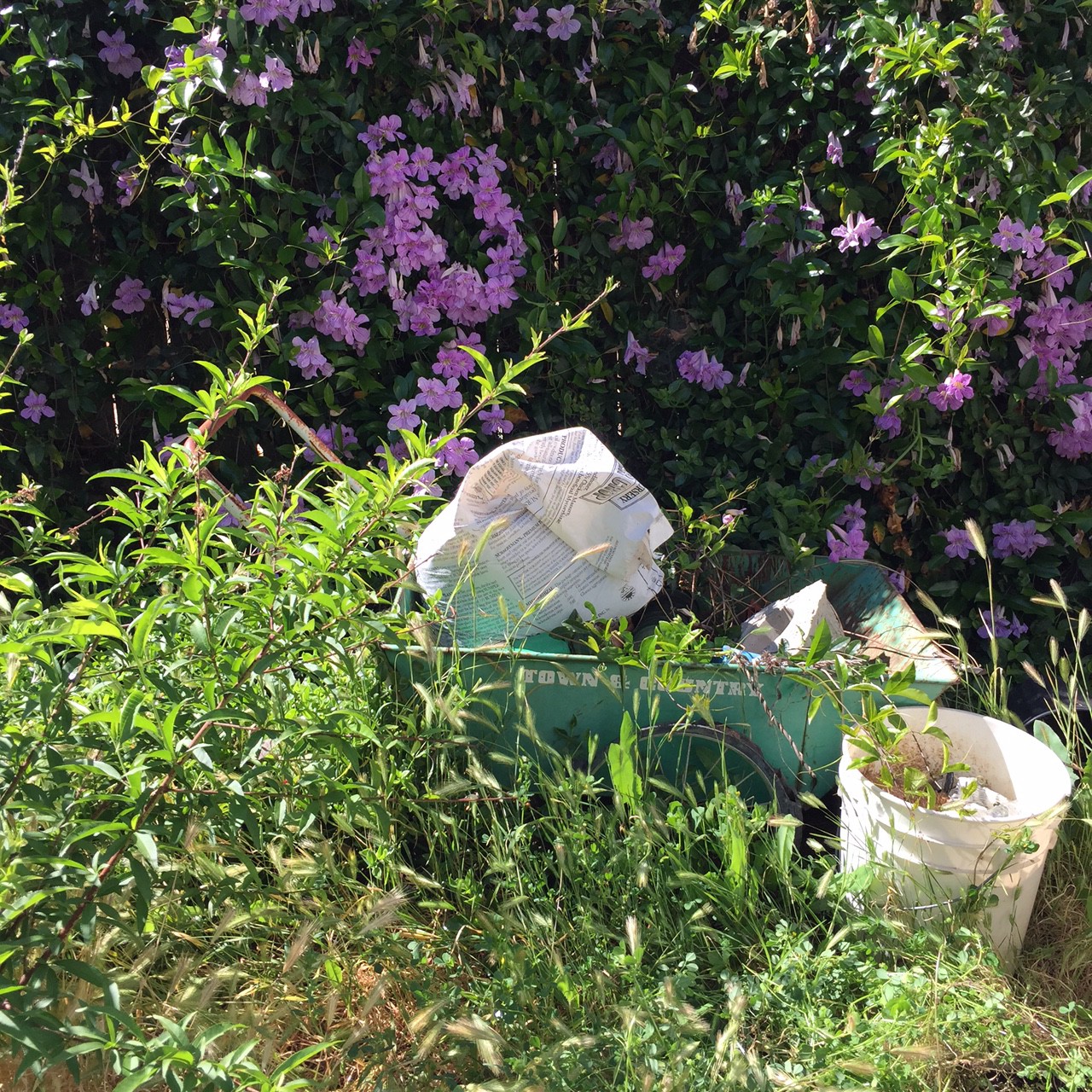
Spring weeds in my garden.
Over the past few weeks, my husband and I have set about clearing, prepping, and planting our garden for the main summer season. Though we live in a climate that boasts year-round growing, summer feeds us color—it is the season we eat rainbows, stuffing our mouths with sun-warmed fruits, painting our bellies, while outside the sun yellows, browns, and reddens our skin. It is the season that waters our mouths when we speak of gardening, as we anticipate the taste of peach, purple, yellow, red, orange, and green-streaked fruits and vegetables.
Earnestly, Saturday after Saturday, we’ve crawled and stooped around our yard, pulling spring-blooming weeds of dandelion, hay grass, mallow, and crabgrass, careful to leave what mint and plantain weeds we have growing alone. Ritually, we go out in spring clearing; mentally, I take note of what new and old weeds have come, choosing to let some run wild, pulling invasive weeds we have no use for, and keeping what I’ve learned to use.
“Weeds are like thoughts, distractions, in a writer’s mind,” I called over a thick patch of dandelions, deeply rooted and setting seed, to Edward. “If my writing mind is a garden, weeds are the distractions that come, intruding, covering up my meaningful thoughts, ideas.”
Edward is an accountant, and though he would tell you he does not have a creative mind, is not artistically-inclined like me and our two kids, his spreadsheets and budget-work often astounds me. He understands numbers the way I understand color, language, and sound.
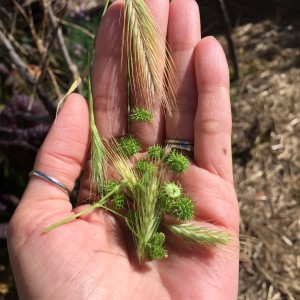
Wild spring grass/weed seeds.
“Think about it.” I pulled and pulled at a deeply rooted, thorn-filled dandelion, eventually falling backwards from my squatting stance to a seating position.
“I’m listening,” Edward said.
“Like this dandelion I just pulled. It is like a distracting idea when I’m trying to write. If I don’t deal with it, root it out, it will grow deep roots and suck energy, light, and space from my real ideas, my creative ideas. It will muddy the colors I’m trying to see.”
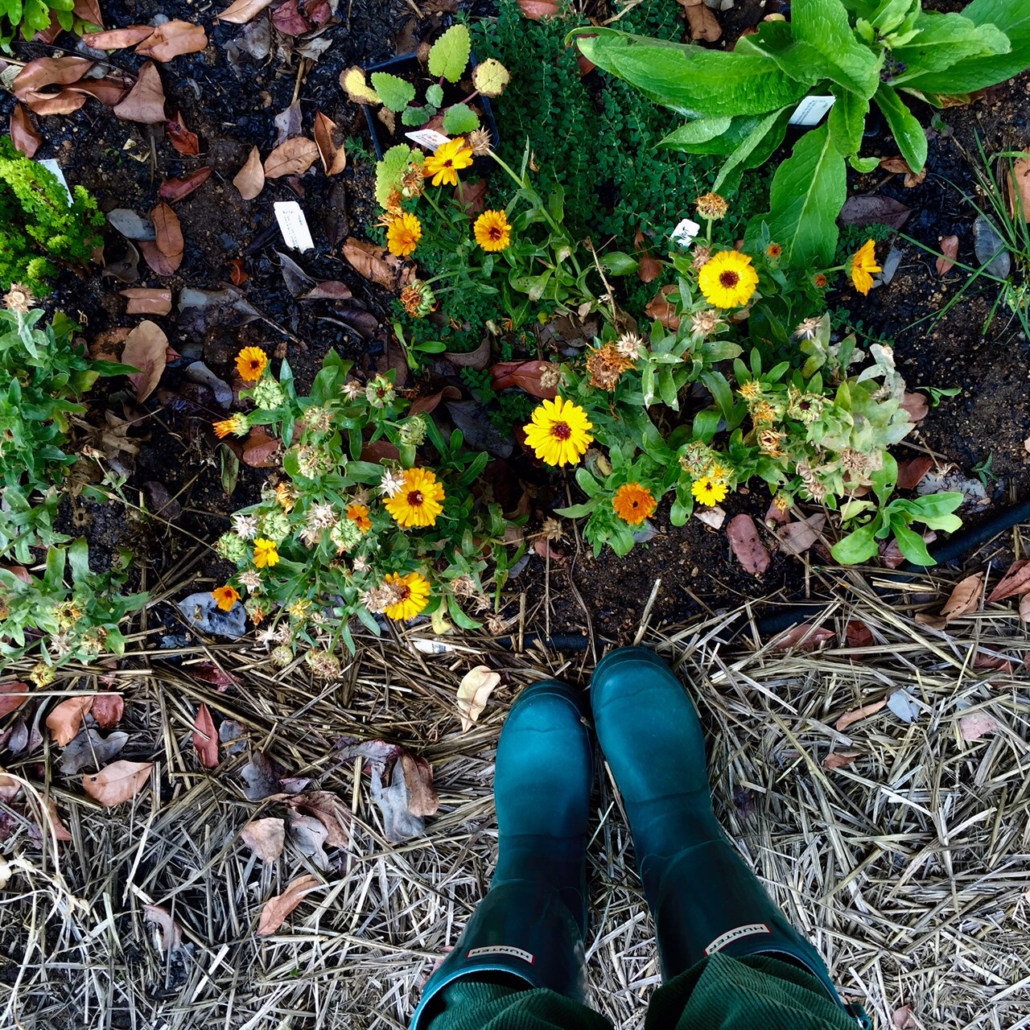
“Okay,” Edward said. He continued to clear his patch of hay grass beneath our peach tree. With blooming calendula and lavender flowers, and newly spent peach blossoms nearby, bees were loud and busy buzzing around him. I wanted to work where he was, letting the bees glide their yellow, black bodies over me. But the thrill was giving me goose pimples, and I was afraid my excitement, my adrenaline would get the bees riled up, leading to my bare arms getting stung.
“Seriously, it is a great metaphor.” I sat in the dirt, staring at the broken dandelion roots. “Take this dandelion. I know I didn’t get the entire taproot. If I don’t do the work of digging down deeper, and getting it all, it’ll come back, stronger. But, if I would have come here two, three weeks ago, the roots would have been weak, I would have easily pulled it up. Now, I have to worry about the roots, and the seeds the wind may carry—I have to work harder to clear this one weed from the garden.”
“I see.” Edward continued to pull and listen as I went on making sense of my writing practice, my life in the thick of weeds and soil.
Soon, the weed patch was too thick to talk and pull, and with my point made, my mind began to think about all the weeds I have growing in my writer’s garden, my mind. Fear. Doubt. Impatience. Insecurity. Comparison.
As we made progress, the shape and space of the garden bloomed. After fifteen years of gardening, and a lifetime of watching my grandparents work their garden, I’m familiar with weed-clearing magic—the joy found in reclaiming space and form. What looked abandoned and wild hours ago soon appeared well-kept, tamed.
Our peach trees appeared wider, our apricot tree taller, the Black Mission fig tree, more mature this year than last, with large, green-lobed leaves. Without the weeds, and the confusion and spatial noise they brought, I could see new forms, colors, characters. The fig leaves were hands giving high-fives to the few clouds scattered in the sky. The bright yellow calendula flowers smiled the same gummy grin my children smiled when their front teeth fell. The lavender flower stalks, somehow, reminded me of the spiral curls that stand up from my hair, combing the wind.
What if I took the same care, and ritually went about clearing my writer’s garden of weeds? What forms, colors, characters may appear without fear, doubt, impatience, insecurity, and comparison? What poems may come if I gave myself space to bloom and feed what nourishes me, instead of thoughts that strangle my voice?
In my garden, winter is the s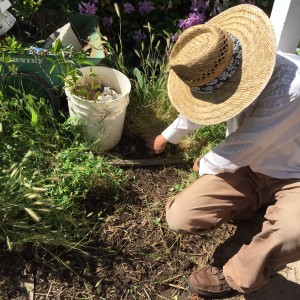 eason of lush greens—purple-green broccoli, yellow-green peas, scarlet red and green chard and beet greens, white-stemmed green bok choy, emerald green kale, and dusty-gray green collards leaves.
Summer, however, is the season of rainbows. Purple tomatillos that ripen nearly black beneath brown-yellow husks, lipstick-red tomatoes and peppers, candy-orange sweet peppers, black-green zucchini, butter-orange squash, juicy-yellow corn, variegated grassy green melons—some with stars and moons, others with sea-wave lines running the full length of their bellies. There are green tomatoes, pineapple-yellow tomatoes, indigo-rose tomatoes, peach-colored tomatoes, orange tomatoes, and pink and purple tomatoes, too.
Color riots the summer garden, with red and yellow running the revolution.
I would never allow weeds to grow wild, without abandon in my garden, browning the rainbow I crave to consume. The rainbow that colors my belly, yellows my skin, and scents my hair purple with the sun.
I’m learning I eat my words, too. My poems scent me, redden my skin, balloon my belly, and fuel my hands to do my work. My work of seeing the world anew, in color and form, and creating figurative language that expands what is familiar to meet what I, we, have yet to understand. My work is the work of metaphors, colors, sounds.
Metaphor takes what we do not know, joins it with what we do, so that we may expand, see and understand the world with deeper, richer possibilities.
Metaphors make the fearful familiar, like gardeners make seeds food, and poets, writers attempt to make sense out of confusion. All acts of creating meaning. I tell you, us writers, we don’t just write what we know, we write towards what we need to know. We write to understand, create meaning, make sense.
I make sense of the world through color, then words, then shapes. Fear does not birth the yellow I long to see, the peach and strawberry-red shades that make me dream my way out of confusion. Neither does doubt paint the sky purple, or green for me. Those weedy thoughts muddy my process; they suck the color out of my world.
“I feel joyful,” I said to Edward cradling a new Reed avocado tree in my lap. My hand gently bent its blooming branches, inward, and cradled it from the wind as Edward drove us home from the nursery with a car filled with new seedlings.
“You’re thinking about your summer garden?” He smiled at me.
“No, I’m thinking of the colors, the poems. The hours the sun will redden and brown my back while I sit at the root of these plants. I’m thinking about the bees, lizards, hummingbirds we’ll feed. Us, too. And I guess the grasshoppers and June bugs, too. I’m thinking of all the poems we’re carrying.”
I urge you to define how you make sense of the world, what inspires you. But also, do the work of discovering the weeds you have growing wild, without abandon, some you’ll find use for, you’ll turn into pieces of art, but others, you’ll learn to discard.
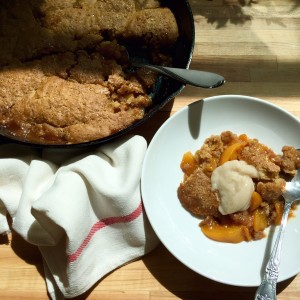
This weekend, while I’m longing for summer peaches, I’ll settle for a homey peach cobbler. It’s a little taste and promise of summer’s riot of color soon to come. Here’s the recipe:
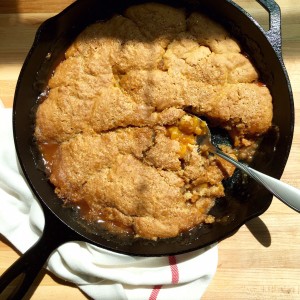
Cast-Iron Skillet Peach Cobbler
This cobbler comforts and soothes after a long day of garden work. I wanted a taste of peaches that would be just as welcomed in the morning or late afternoon as in the evening for dessert. So, it isn’t overly sweet, but it is peachy and warmly satisfying. It’s wonderful served with a spoonful of vanilla yogurt in the morning or early afternoon for breakfast, and decadent warmed and served with vanilla ice cream on top. Cooking it in a piping hot cast-iron skillet caramelizes the peach syrup and deepens the flavor, so if possible, don’t skip that step.
Peach filling:
4-5 c. sliced peaches (canned [drained], frozen, or fresh)
1/3 c. brown sugar
¼ c. white sugar
2 tbl. butter/margarine
1 ½ tsp. cinnamon
½ tsp. cardamom
½ tsp. freshly grated nutmeg
pinch of salt
2 tbl. almond milk
1 tbl. cornstarch
Cobbler topping:
1 c. + 2 tbl. flour
1 tsp. baking soda
3 tbl. brown sugar
½ tsp. cinnamon
½ tsp. fresh grated nutmeg
5 tbl. butter, cut into cubes, plus an additional 2-3 tbl. to butter the skillet
2/3 c almond milk + 1 tsp. apple cider vinegar
2 tsp. vanilla extract
1 tbl. turbinado/raw sugar
Directions:
- Preheat the oven to 425 degrees, place the cast-iron skillet in the oven to heat.
- Place the peaches, sugars, butter, and spices in a small pot over medium heat and cook until the peaches began to release their juices and mix with the sugars, about 10 minutes. Meanwhile, in a small bowl mix the cornstarch into the cold milk and form a slurry. When the peach juices just start to bubble/boil, stir in the cornstarch slurry and cook until the juices thicken, another 3-5 minutes. Set aside.
- Place 2-3 tablespoons of butter in the cast-iron skillet and let it melt and brown in the oven while you prepare the topping. Add the vinegar to the milk to curdle, set aside. Mix flour, baking soda, sugar, cinnamon, and nutmeg in a large bowl. Cut butter cubes into flour mixture, mix until course crumbs form. Stir the vanilla into the curdled milk, then add all at once to flour/butter mixture. Mix quickly, and lightly, until no white flour remains, but being careful not to over-mix.
- Carefully (it will be hot) remove the cast-iron skillet from the oven, and very carefully pour in the cooked peach filling. The skillet will be much hotter than the filling, so be careful that the melted butter doesn’t splash or pop on you. It should sizzle and make a lot of noise, this is good—you want the sugars in the filling to lightly caramelize to deepen the flavor.
- With a large spoon, drop spoonfuls of the topping over the peaches, spacing them out. As it bakes, the topping will spread, covering the peaches with a ‘cobbler’ like topping. Sprinkle the turbinado/raw sugar over the topping.
- Bake for 20 minutes, until the topping is brown.
- Enjoy!