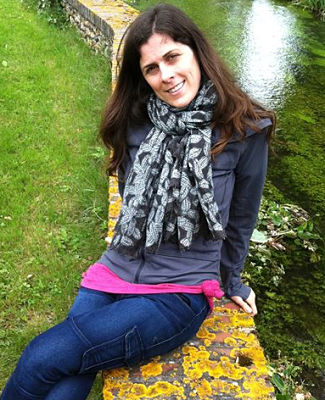
Maggie Nelson, Author of The Red Parts
 In early July, my editor-in-chief emailed me with the good news that Maggie Nelson had agreed to be interviewed for Lunch Ticket. I accepted the task of interviewing her with some degree of trepidation, in part due to her vast accomplishments. She is the author of nine books, including the winner of the National Book Critics Circle Award, The Argonauts, the cult classic Bluets, the New York Times bestselling The Art of Cruelty: A Reckoning, and The Red Parts: Autobiography of a Trial, as well as five books of poetry. She directs the MFA writing program at CalArts and lives in Los Angeles with her partner, interdisciplinary artist Harry Dodge. Nelson has also received a 2012 Creative Capital Literature Fellowship, a 2010 Guggenheim Fellowship in Nonfiction, a NEA Fellowship in Poetry, an Andy Warhol Foundation/Creative Capital Arts Writers Grant, and, most recently, a MacArthur Foundation fellowship.
But I was also unsettled because within the canon of books that I would need to read or re-read for this interview were Jane: A Murder and The Red Parts: Autobiography of a Trial, both concerning the murder of her aunt in the early 1960s in Michigan by a serial killer. Unfortunately, like Maggie Nelson, I understand “the murder mind,” an appellation she uses to describe the headspace we inhabit each time we seek to comprehend incomprehensible acts, thereby imprinting on our minds the behaviors of violence. To delve into Maggie Nelson’s work, I would be reopening certain wounds within my own history.
In July of 2014, my forty-eight-year-old cousin was found dead from a single gunshot wound to her left temple in her home in Santa Cruz, Galapagos, Ecuador. The cause of death was officially a suicide, though it was not long before inconsistencies emerged. There was no gunshot powder on her left hand, there was evidence of a robbery, but most obvious, there was the phone call she made to her mother the day before her death, expressing how she was afraid—she had said something she shouldn’t have—and she needed to fly home. What began for my family as a tragedy became the uneven practice of grief, a maddening search for answers, and the honest, yet naïve, desire for justice. We barely succeeded at the first task.
In 2005, Maggie Nelson published Jane: A Murder about her aunt’s murder, a cold case, which had remained unsolved for thirty-five years. The work combines essay, poetry, and Jane’s own diary entries. In her exploration of Jane’s death, the search for the truth reads more like an ellipsis, delineating, perhaps by omission, this young woman whom Maggie Nelson never met but who held so much space within her family history. Missing persons, dead or disappeared, create vacuums that shadow us and redefine us in the process. Our “murder mind” flitters around the absence, the empty space left behind by so many unanswered questions.
There’s something very difficult about writing autobiographical books in which one’s goal is to speak for oneself only, while at the same time wanting to make a text porous enough that other people’s experiences feel invited in rather than consciously or unconsciously excluded.
For Nelson, growing up under the specter of a violent crime, she dissects how it followed her family wherever they went: how she would check the closets upon returning home from school, knife in hand, or how she and her mother had to leave movies that featured the kidnapping, murder, or rape of women (a trope repeated all too often in Hollywood), or how her mother remains startled by her own body, dreaming perhaps “of a body that cannot be injured, violated, or sickened unless it chooses to be.”
Maggie Nelson does not have the answers, but she asks all the right questions, at least the ones we ask quietly, never aloud. She writes, “Conventional wisdom has it that we dredge up family stories to find out more about ourselves, to pursue that all-important goal of ‘self-knowledge,’ to catapult ourselves, like Oedipus, down the track that leads to the revelation of some original crime, some original truth…” But the reality is far more complicated. She says, “Fewer people talk about what happens when this track begins to dissolve, when the path starts to become indistinguishable from the forest.” And so what happens when we get what we desire, this truth? What are we left with? To whom does the truth even belong?
One month after reading the galleys of Jane: A Murder, Nelson’s mother received a call from a detective. New DNA evidence had re-opened the cold case. Gary Leiterman, a sixty-two-year-old nurse, overweight and in poor health, would be prosecuted for the murder of Jane Mixer. Nelson’s family inevitably would relive the gruesome details of Jane’s death in the courtroom, presented with autopsy photographs, visual evidence, and testimony. And for her part, Nelson chose to re-enter the “murder mind” and write an account of the trial. The result, The Red Parts, was first published in 2007 by Simon & Schuster and reprinted by Graywolf Press in the spring of 2016.
It begins with two epigraphs: “For there is nothing covered, that shall not be revealed; neither hid, that shall not be known” (Luke 12:2) and “In all desire to know there is already a drop of cruelty” (Nietzsche). Later in the book, Nelson seeks a Christian friend’s advice and the woman instructs her to “just read the red parts,” which at first she does not understand. Though the significance of the title is never explained, the literal meaning refers to those Bibles which have Jesus Christ’s direct quotations highlighted in red. The quote from the gospel of Luke, its own “red part,” sets up the counterbalance to Nietzsche. In the kingdom of God there is justice, just don’t expect it to look like anything you might recognize.
The Red Parts goes where Jane: A Murder could not. Out of nothingness, there is now Leiterman and a body of evidence no longer dormant in cardboard boxes. And yet, to Nelson, these heavy facts sometimes make even less sense than the unanswered questions. She is fascinated by the way in which murder transforms the mundane items of a crime scene into “talismans that threatened at every turn to take on allegorical proportions.” Referring to a bloody towel presented as evidence, Nelson says, “… I watched Schroeder snap on a latex glove at the January hearing and pull this towel out of its cardboard evidence box, as if retrieving a piece of flotsam floated in from the far, dark banks of the River Styx. The fabric of reality had to tear a little to allow it into it.” The fabric of our reality must tear a little as well to let this book in: to feel what it’s like on the other side of violence. There is an image I cannot shake either: my cousin wore a short strand of black pearls around her neck the night she was killed. Afterwards, the pearls were found shot across the floor like marbles. I return to this: the pool of blood, the black marbles, the curled body, as if from those mental snapshots I can somehow process my loss.
In The Red Parts, Nelson broaches a theme to be continued in The Art of Cruelty, about how the female body is a site of consumable violence. It is not theoretical: she watched its consumption through the body of her aunt, the autopsy photos disseminated at the trial, republished, and consumed by a specific audience. A television show, 48 Hours Mystery, will feature an episode on Jane, whether or not the family participates. Nelson and her mother agree to be interviewed for the show, but Nelson is keenly aware of the inherent contradictions within their publicized grief. She wonders about the public’s concern over the damaged bodies of young white girls, from middle to upper class backgrounds, and poses the question: “Girls whose lives and deaths, judging by airtime, apparently matter more than all murdered, missing, and suffering brown people combined?” Nelson never shies from to putting her finger right in the throbbing wound, even if it implies that she participates in that wound.
I remember coming home from the hospital after giving birth and looking completely differently at all birth mothers on the street for a few weeks, feeling simply astonished that they’d all been through this experience, which remains mostly removed from us, like some giant secret, separated from daily life by a cordon sanitaire.
What makes The Red Parts so accessible is Maggie Nelson’s sense of detachment, a calm analysis that manages both the horror and untranslatable magnitudes of life. In The Argonauts, it is her pregnancy and childbirth, her mother-in-law’s death, and her partner’s decision to transition with testosterone supplements and surgery. In Bluets, it’s her friend’s car accident and paralysis. Woven throughout The Red Parts are numerous personal tragedies: the sudden death of her father from a heart attack, the period of heartbreak she experiences at the beginning of the trial, her heroin addict ex-boyfriend, her sister’s troubled youth. Yet the text never feels laden with sensationalism or sentimentality.
At various times reading her work, I have felt as if we were sitting together on a couch, giggling (perhaps inappropriately) at dismal things. I have also felt that we may have lived parallel lives. This is obviously far from the truth—no one lives parallel lives. But it is a testament to her uncanny ability to connect with her readers. In The Argonauts, Maggie Nelson argues against binaries as a reductive system of thought. Instead, she refers to identities that flicker in and out, over spectrums, over time, shape-shifting. And perhaps this is why we are able to see so much of ourselves in her writing. She presents a multiplicity of perspectives. Within her work, contradictory emotions can exist simultaneously. In the interview below, she refers to her work as “porous,” so that within these juxtapositions, we have the space to incorporate our own interpretation, creating a positionality and sense of belonging to the text. But underneath it all, Nelson remains committed to revealing our most damaging societal paradigms: racism, misogyny, homophobia, transphobia, or any system of thought that creates unequal power dynamics.
This past August 2016, I contacted Maggie Nelson and we exchanged emails with questions regarding her body of work.
Diana Odasso: You address a number of binaries in The Argonauts, not just in gender and sexual preference, but also in academic disciplines and how these relate to the materiality of the body. With regard to gender and identity, you mention the identity as something that “flickers” or “becomes” rather than existing on a linear spectrum from A to B.
Yet in the “outside” world, the demand for labels remains high. The government defines. Society defines. Passports, social security cards, mortgages and health care, etc… The humiliations of daily life are particularly hard on the LGBTQ community. I’m not sure if this is your job as an artist to answer, but how can we move from a personal framework of fluidity to a societal framework?
Maggie Nelson: Well put. I think there are many others who could answer your questions better, activists working to remove gender designations from identifying documents, for example, and so on; some countries are already way ahead of the U.S. on this account, so there are some promising models out there.
My critique of the value of video testimonials still stands, which is to say that in an age of “truthiness,” the idea that a condemning video would guarantee, say, convictions of police officers in the wrong, remains a fantasy.
I definitely think that the rush to define and grant rights to a “transgender subject” will be faulty if there isn’t room for the spectrum you describe; otherwise the definition/ recognition/ construction of one subject can become a means of neglecting those whose desires and identifications don’t fit the new box (a perennial problem with defining subjects). You’re right, though—I address these issues most often as an artist more than an activist or advocate per se. I’ve seen first-hand, however, in the eager and grateful reception of The Argonauts, how large the appetite is out there for an insistence on our capacity to make community and commons without basing such in calcified or over-determined identities—something a lot of folks insist can’t be done, but the thing is, it’s already happening, it’s already been done, it’s ongoing.
DO: On the issue of binaries, you challenge the rigidity of both mainstream and radical ideas in your work. This questioning seems to be a useful tool as we redevelop our language surrounding gender and sexuality. How’s the new dialogue being created? Who’s defining it? When the world seems obsessed with the clinical definitions of who gets to pee where and in what receptacle, how do you suggest a nuanced discussion of gender in mainstream society? What space does art have in influencing long-term changes in this dialogue?
MN: I read the New York Times every day and assorted other media sources, but generally speaking, I don’t venture into mainstream Op-Ed modalities because I just don’t think the available forms allow for the nuanced discussions I value most. That isn’t to say there aren’t excellent think pieces or provocations in those forums, or that mainstream visibility performs no function. It’s more to say that the mainstream is often just waking up to issues, or to people, that have existed for some time, but it has the habit of treating them as “new trends,” which is annoying. For example, I’ve heard a lot of people lightly mock this “transdy” moment, when trans and queer issues are suddenly very visible in mainstream venues, but sometimes their scorn slips into focusing on the people who are coming into view, rather than on the venues whose stock in trade is creating the feeling of trendiness. That’s a trap I think we need to watch out for, as it discounts history, it discounts the people who’ve been living and fighting along these lines for a long time without many headlines or fashion shoots.
DO: The Argonauts addresses motherhood full frontal. You write, “Phrases like colostrum, letdown, and hindmilk arrive in one’s life like hieroglyphs from the land of the lost.” Many American women, myself included, enter pregnancy, labor, and early motherhood largely unaware of its physiological demands. Other than doctor’s advice, Good Housekeeping magazines at the ob/gyn’s office, and online mommy wars, childbearing and -rearing remain somewhat of a black hole in our society. Why the erasure of what you term “biological maternity,” both in literature and cultural narratives?
MN: You know, misogyny, matrophobia, etc. The usual suspects. The fact that most things associated with caretaking are feminized and our culture has a long history of despising the feminized. I’ve never in my life received more shocked gasps at a reading than when I’ve read my very simple attempt to describe what my placenta looked like; I naively had no idea beforehand that I was going to provoke such a response. Similarly, so many people have expressed pity for me for my “hard birth experience,” whereas I thought I was narrating a triumphant birth experience. But because there’s pain in it, and fear and blood and mortality, people think it’s a trauma, when really it’s just life. (As one nurse hilariously said to me during my labor, “This isn’t for sissies.”) I remember coming home from the hospital after giving birth and looking completely differently at all birth mothers on the street for a few weeks, feeling simply astonished that they’d all been through this experience, which remains mostly removed from us, like some giant secret, separated from daily life by a cordon sanitaire. Anyway, I don’t know that childbearing and rearing is a black hole—I think the fuzzy, mystified version (what some might call reproductive futurism) is just about everywhere. Needless to say, my interest lies elsewhere.
DO: In The Art of Cruelty, published in 2011, you discuss theories of represented violence. Since then, we’ve seen a proliferation of iPhone videos depicting police brutality, sniper shootings, terrorism—acts perhaps not vastly different from violence we’ve seen before but now occurring “live” with more frequency. (I remain most marked by the policeman shot during the Charlie Hebdo attack and recently, the Philando Castile video. They haunt me not for the killing, but for the subtle moments of humanity, for the dying.) If you were to append The Art of Cruelty in any way, what could be learned of our increased consumption of “real” violence?
The fact that most things associated with caretaking are feminized and our culture has a long history of despising the feminized.
MN: I don’t think I would need to append it. It reminds me of the re-release of The Red Parts, when people have asked me, “What would you add now that true crime is such a huge industry?” It was a huge industry when I wrote those books, too, and it was huge when my aunt was murdered in 1969. I think my critique of the value of video testimonials still stands, which is to say that in an age of “truthiness,” the idea that a condemning video would guarantee, say, convictions of police officers in the wrong, remains a fantasy. (Rodney King, anyone?) Which isn’t to say I’m not pro body cameras or websites to which videotaped incidents can quickly be uploaded, etc. It just means it’s important to remember that such things alone won’t solve the problem of white supremacy and an unjust criminal justice system. But your other point is really interesting—your point about witnessing the subtle moments of humanity, about being haunted by the dying, rather than riveted by the injustice or the violence. Personally I can’t watch the violent videos; the pregnant pause between the cop’s demand that Sandra Bland put out her cigarette and her decision to say, “It’s my car, I’ll smoke in it if I want to,” contains enough agony for me.
DO: You have often brought up issues of intersectionality, moments when you acknowledge the additional burdens placed upon brown bodies.
When the attack at the Pulse nightclub in Orlando occurred, it became clear that our media had limited ways of addressing intersectional issues—with the majority of victims black and Hispanic, members of the LGBTQ community, but Americans nonetheless, on American soil. Similarly, the murderer was Muslim, also an American citizen, a lone wolf killer, a man who had a history of domestic violence and psychological problems and also documented conflicts about his sexuality. He fit and did not fit several narratives at once. How would you begin to articulate the complexities of these acts of violence?
MN: You just articulate them, I guess. Life is messy, identities are messy, motivations are messy. The public silence from the terrorist-obsessed right wing over the targeting of LGBTQ people of color speaks for itself, but it’s not really surprising. (Remember when the Twin Towers fell because of the gays and feminists?) Anyway, I recommend a book by Ken Corbett called A Murder Over a Girl, about the killing of a high school student Letitia/Larry King by a fellow classmate, Brandon McInerney, as it documents the difficulty of prosecuting a hate crime when various “hates” at issue are all swirled together, or certain hates remain unspoken (transphobia, in this case); or when a human being is full of aggression and just shopping the available avenues of hatred for an outlet. It’s much more pragmatic, in my estimation, to go all-in for gun control rather than trying to parse out which impulse most prevailed in someone’s psychotic decision to kill people.
DO: The Red Parts: Autobiography of a Trial was just re-released by Graywolf Press. This book challenged me. In 2014, my cousin was murdered in the Galapagos. In a recent LitUp podcast, Angela Ledgerwood also mentions how she trembled while reading The Red Parts because her co-worker had been murdered.
There are a variety of angles from which your readers can enter your “world,” as I did with The Red Parts, as many others may have done with Bluets or The Argonauts. I wonder how you position yourself in regards to the relatability of your work.
MN: I’m so sorry to hear about your cousin. Really sorry. It doesn’t bring me any pleasure to have people “relate” to the book’s material, especially as that relating just underscores the widespread nature of violence against women. But if the book offers a kind of rumination or positionality that feels worthwhile or companionable, I’d be very glad. I’ve heard from people who have felt this way, and it pleases me. There’s something very difficult about writing autobiographical books in which one’s goal is to speak for oneself only, while at the same time wanting to make a text porous enough that other people’s experiences feel invited in rather than consciously or unconsciously excluded. These questions are fascinating and mysterious to me, especially as they have both aesthetic and political dimensions.
DO: I was struck by your Nietzsche quote at the beginning of The Red Parts: “In all desire to know there is already a drop of cruelty.” Has writing these books at times been a self-afflicted cruelty?
MN: Oh yes, it’s felt that way. That’s partly why I chose that epigraph. There are different types of the “desire to know,” of course—there’s the Enlightenment type, the psychoanalytic type, the more spiritual type, and so on. That epigraph was meant to dance with the quotation from Luke, which appears next to it, and ask questions about the Biblical structure of revelation. But I digress.
It’s much more pragmatic, in my estimation, to go all-in for gun control rather than trying to parse out which impulse most prevailed in someone’s psychotic decision to kill people.
DO: Could you say a bit more about the title of the book, The Red Parts? I went to a Baptist middle school, in which the bibles had red writing for all the words spoken by Jesus Christ. The quote from Luke you just mentioned is literally “a red part.” How do “the red parts” function thematically, or perhaps theologically, in the text?
MN: At the risk of sounding tautological or close-mouthed, I would say that the thematic or theological function of the “red parts” in the text is up to the reader. As Nietzsche is famous for presenting (allegorically) the death of God, and for complicating notions of good and evil, it’s obviously meant to be charged, placing his words next to the text from Luke. It’s an undecided relation, as is most else in the text.
DO: In The Art of Cruelty, you write, “Writing, especially autobiographical writing, can be a hothouse of self-deceptions, but it also has the uncanny ability to expose self-deception with the formidable exactitude of surgery.” As you have written these personal texts, have you found yourself in this position of confronting your own self-deceptions?
MN: Oh yes, once again. That’s kind of the whole game. Every draft is slathered with self-deceptions. Or if that puts it too harshly, every draft is full of layers—usually I start off pissed off, blaming others, the way we all tend to do, and I have to burn through those very human habits before getting anywhere interesting. Again, one’s writing reflects where you are in life; you can’t hide. If you’re full of blaming rage toward your folks, and you haven’t yet worked through it, that’s what is going to come out. You can’t just jump over it to forgiveness (if that’s even where you want to go). You have to go through it, as they say. But the amazing thing is, writing freely and then looking honestly at what you’ve put down on the page is, in my experience, a really good way of moving through things. This is why teaching autobiography can be so hard—if you’re a shrink, you know that you can’t tell someone something they aren’t ready to hear and expect them to take it in, rather than freak out in defensiveness. But if you’re a writing teacher, you might have to deliver the news before someone’s ready to hear it, because you only have one workshop, or one semester. I can’t tell you how many students have told me that they finally understood what I or their classmates were trying to tell them about five years after they’ve graduated. I’m still catching up to things people have told me along the way. It’s painful and embarrassing that we’re often so clear to others and so muddled to ourselves. But so it is.
DO: Harry has spoken about being a character in The Argonauts, stating that being with you, “Is like an epileptic with a pacemaker being married to a strobe-light artist.” You address the dangers of writing about loved ones and, even, the temporal dissonance between the time period you write about and the book release, which is a reliving of the past. I wonder if you could speak to that process with the release of The Argonauts.
MN: Well, we made it through a long year of a lot of publicity, so that’s something! The book garnered way more attention than I ever imagined it would, which was amazing, but presented a tough learning curve for me at times, especially in the face of media people who really, really wanted me to tell them more about Harry (or about his gender, to be exact) or even speak for him, when I had already said what I had to say about him (and what he authorized me to say) in the book, and I wasn’t aiming to travel around as an emissary to explain him or any other genderqueer person to the world.
There’s something very difficult about writing autobiographical books in which one’s goal is to speak for oneself only, while at the same time wanting to make a text porous enough that other people’s experiences feel invited in rather than consciously or unconsciously excluded.
Also, while I usually have a pretty thick skin re: reviews that get things wrong, it wasn’t as easy to ignore misrepresentations of the book if they involved Harry as well as me—for example, a line that recurred quite often was that the book was about my undergoing “arduous IVF treatments” while my partner “transitioned from female to male,” which isn’t true on either account. So in some visible cases, like the New York Times, I asked for a correction, which they issued. Anyway, I’m glad the rush of it is over, and also grateful for the ride.
DO: In a Rumpus interview, you say, “[Annie Dillard] once wrote, ‘You don’t run down the present, pursue it with baited hooks and nets. You wait for it, empty-handed, and you are filled. You’ll have fish left over.’” And you also say in first pages of The Argonauts, “You can’t fuck up the space for God.”
On one hand, your books are tightly constructed, but on the other, there is a space for reflection, for disagreement, and for the interplay of opposing ideas. How is the notion of space formally used in the construction of your texts?
MN: Space is really important. “Pluralize and specify,” as Sedgwick had it. I wrote a lot about space in the Cruelty book, so I’d direct interested parties there for more cogitation on the subject. But you’re right, space between paragraphs is the only formal device in The Argonauts—there’s either one or two. That’s it. Space in Bluets was marshaled numerically; in The Red Parts, the logic of space was the chapter.
DO: In a video interview with Olivia Laing at the London Review Bookshop, you challenge the idea that your works are collage, which implies simultaneity. You also mention that you have moved away from poetry in your recent books, because the narrative form “does more work.” Does the subject matter dictate form or are you open to new manners of experimenting? What are you working on now?
MN: Subject matter dictates form. Given that, I can’t really talk about what I’m working on until I’ve found its true subject and consequent form. But I’ll keep you posted!