
Wild Greens Ring in the New Year
Long years after my great-aunt Nora and great-grandaddy Herman passed, a patch of greens grew wild behind their duplex houses, inherited by my mother. The collards showed up earnestly, in broad clusters of green, some summers a little tattered for the sun’s wear.
In the back of my mind, for a few years now, I’ve rolled an image-memory again and again of this old greens patch. We writers tend to do this—carry images, memories, ideas in us until we can find words or page to root them. We carry them with us for miles in our everyday lives, waiting for them to mature, to land, to live somewhere outside us.
“Mama, what’s this growing?” Always, in my memory, Mama asks Granma about the wild patch of greens growing.
In some memories Granma picks a few leaves to carry home, a few blocks down the road. In other memories, Granma doesn’t pick the greens. Either way, she stands there musing about the leaves, her hands on her hips, pocketbook hanging from her left wrist, sunlight pouring through the triangles between the sides of her body and her arms. The light is warm orange, glowing with L.A.’s afternoon haze.

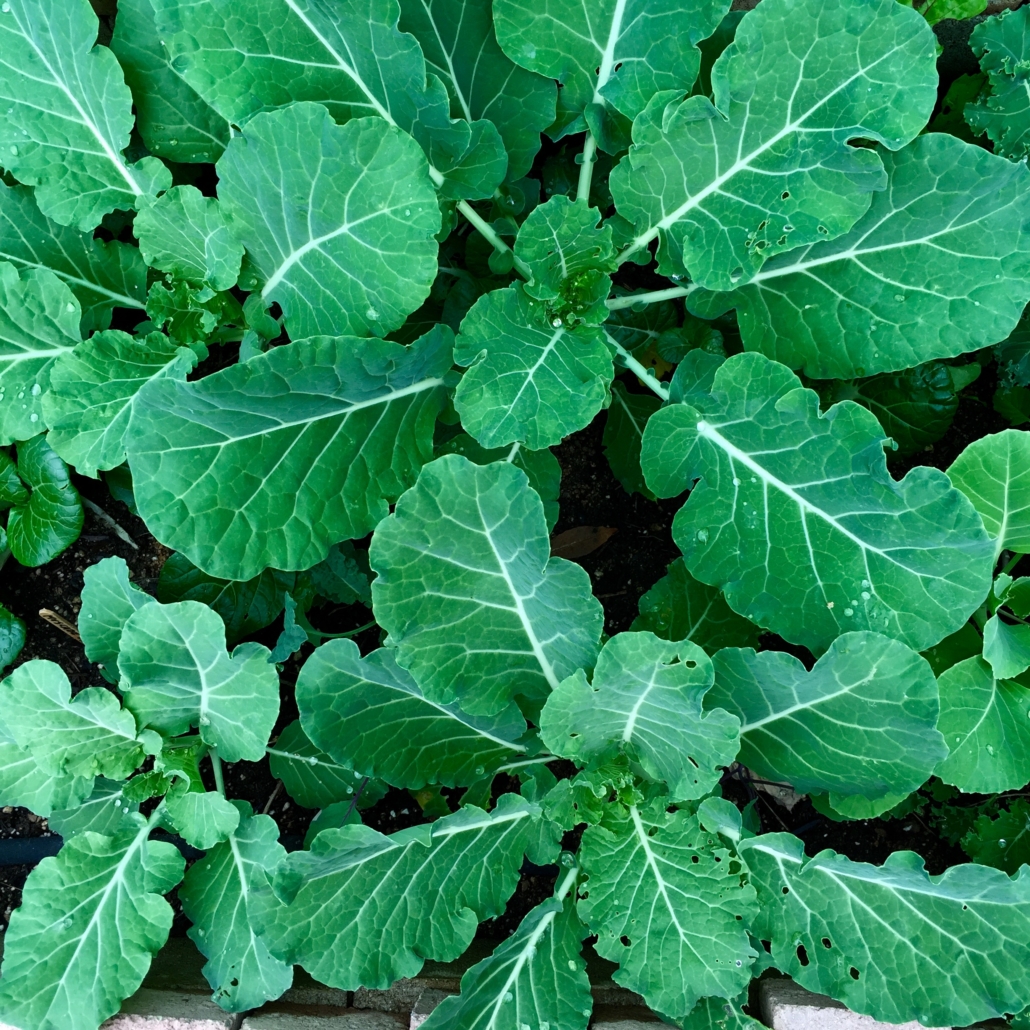
Flowering Hon Tsai Tai surrounded by Swiss Chard and Cauliflower. © 2015 Kiandra Jimenez
“Nora and Daddy’s greens.” Granma bends over, rubs the leaves of the wild-growing collard plant between her fingers. Always, in all the memories, Granma identifies the plant as aunt Nora and great-grandaddy’s greens.
I’m not sure which memory is right, or if they both hold pieces of the truth. It is likely the memory loop has been chopped, reordered in the miles I’ve traveled with it.
A few things I am sure of—it was the middle of summer; Granma, Mama, and I were standing in the backyard of Mama’s house waiting for Papa (my grandfather) to finish his remodeling work for the day. He had just pulled all the walls and floors down off the back house, exposing the old wooden beams. These houses, moved just a few miles from their original foundation to make way for L.A.’s 110 freeway, had been in the family for decades. Once aunt Nora and Grandaddy’s houses, now they were Mama’s houses. Granma would tell us aunt Nora bought each house for a dollar; the only real cost was moving them through the city and putting them on land.
When I notice I’m carrying an image-memory I mull and ruminate, in an effort to guide it to the page. How do I honor this, why do I hold and carry it, how do I want this memory-image to live outside of me? I push myself to find the memory’s purpose in my life.
These years, aunt Nora, great-grandaddy, Granma long gone, I walk my own garden, tending our food, observing what’s wild-growing, what the bees are feeding on, where the aphids, cabbage loopers, or slugs have migrated, looking for what’s ready to harvest. I come from many generations of farmers—Grandaddy and Big Mama were sharecroppers in Tennessee when Granma was growing up, and all generations before them were farmers. When my family migrated west, and settled in California, they brought their gardens, their ways of growing and raising food. I’ve come to believe my blood is green.
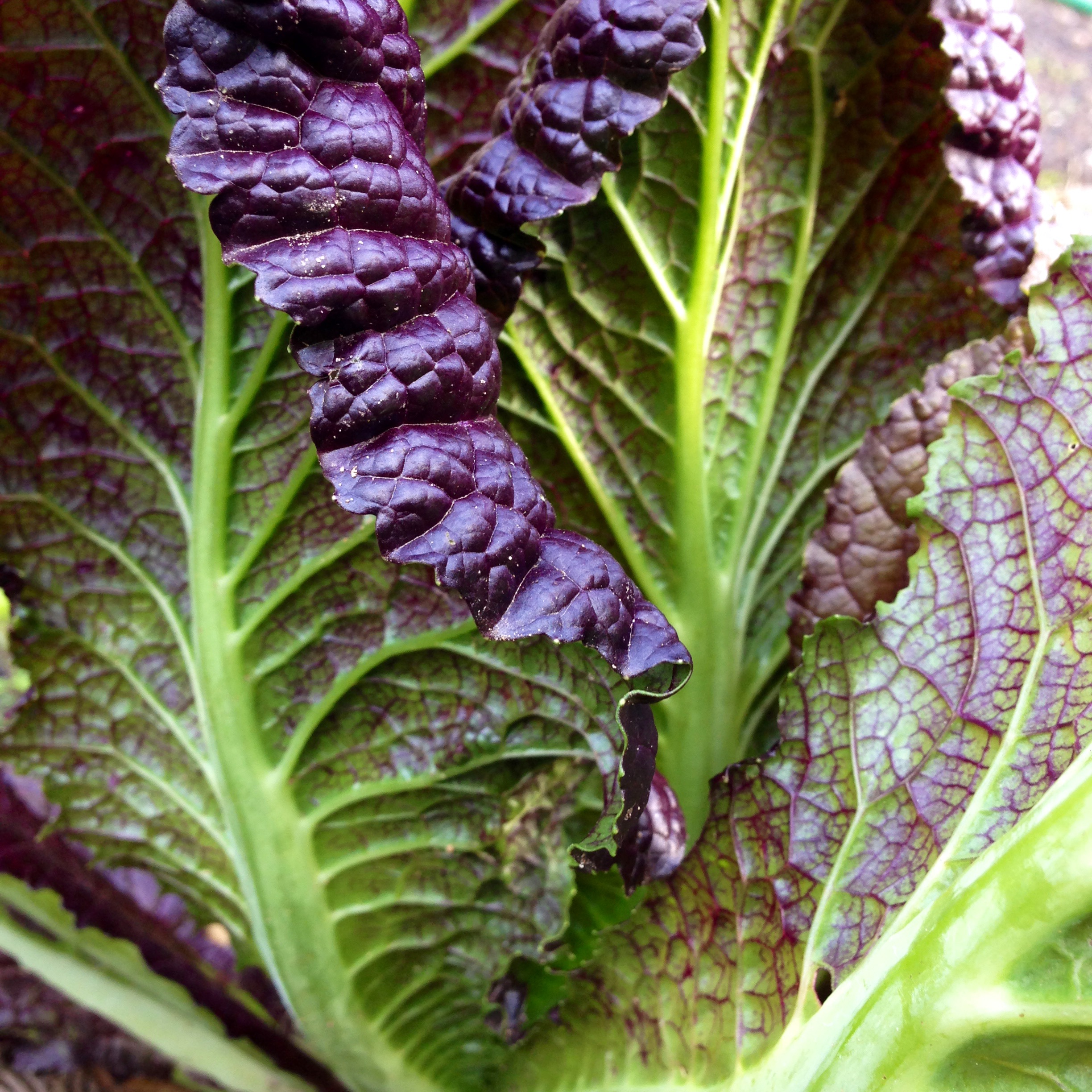
Red Giant Mustard Greens © 2015 Kiandra Jimenez
In fall, Red Giant mustard greens grow wild in my garden; they are stately, regal, growing tall well into the deep heat of our inland summers. In August they rest till October. They are everything their name implies—giant and violet-red and green. Along the leaves’ edges, they scallop and fold in grooves and hills, often causing the older leaves to curl inward, as if the mustard greens are hugging wind. Its ribs are loud, neon green, stunning against its moody, sensual merlot skin. Its under-skin, the side beneath the burgundy mounds, is covered in a complex pattern of maroon veins on broccoli-green skin. When pricked with a nail, the leaves smell of fresh cabbage and broccoli—slightly sweet, hints of sulfur, but nothing speaks of their raw, peppery bite.
I’ve come to believe gardens hold a piece of our souls in the soil. When we toil, we spill sweat, spit, blood, our energy and intentions into the ground; we give ourselves over to the work and life of Nature, and in return, she feeds us. I like to imagine Nature takes what we offer of ourselves and adorns what grows with those pieces of us. It’s how I’ve started to understand a part of my purpose in Nature’s cycle.
Is writing not like a garden? We toil ourselves over the page, spilling sweat, blood, tears, our energy and intentions into our stories, poems, memoirs. We deliver ourselves, our lives to the page, and in return, she feeds us. She adorns what readers read with pieces of us, they feed, and in a twist of synergy, for a time we writers and readers become one. Not unlike us gardeners becoming one with our food, and us consumers becoming one with our meals.
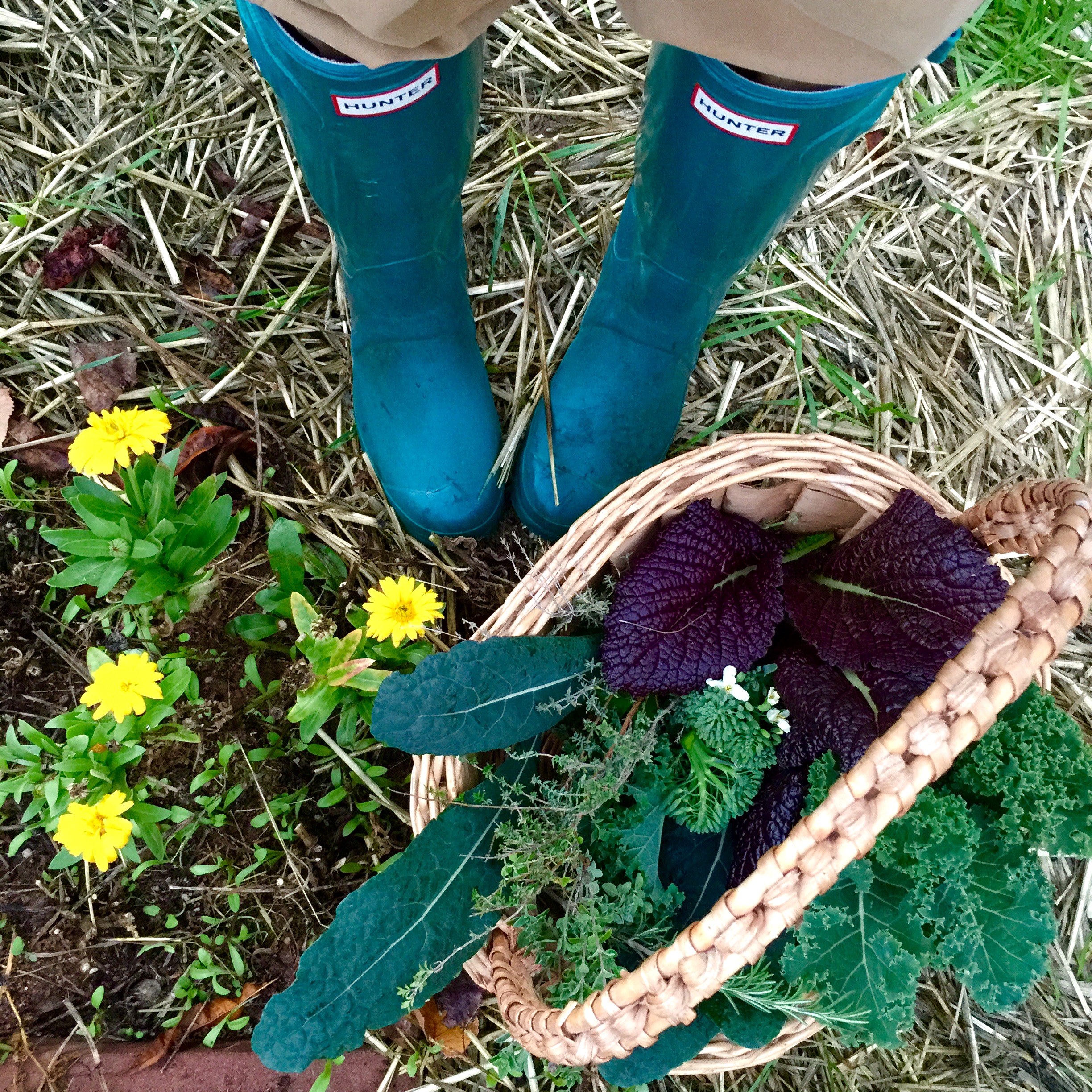
New Year’s Harvest (Mustard, Kale, and Collard Greens) © 2015 Kiandra Jimenez
Thursday I picked greens from my garden—collards, kale, mustards, and turnips for our New Year’s dinner. Granma kept with tradition making black-eyed peas, greens, cornbread, and yams for New Year’s, so I do too. Keeping both her and tradition alive. The peas symbolize luck, the greens bring money, the cornbread represents gold, and the sweet yams are for love and health.
My garden, like my food and writing, tells you who I am. Traditional, thoughtful, yet wild around the edges, colorful and soulful. I carry Granma, my people, and a touch of the south in my mouth. Like Granma I muse over collard and mustard leaves in the sun. Like great-aunt Nora, and great-grandaddy I grow wild greens.
While picking greens yesterday I began to get a sense where the image of aunt Nora and great-grandaddy’s wild green patch lives—in my own garden and kitchen. As I go through the process, yearly, of tending what grows, feeding my family recipes passed down generations, I’m also feeding them story and history of who we are. And, these stories matter. My image-memory will become story, passed on, but it will also become a way of living in harmony with the land, of eating close to Nature, of culture and tradition, too. It will become a way for my children to understand who they are, how they relate to Nature, and the generations that have come before them.
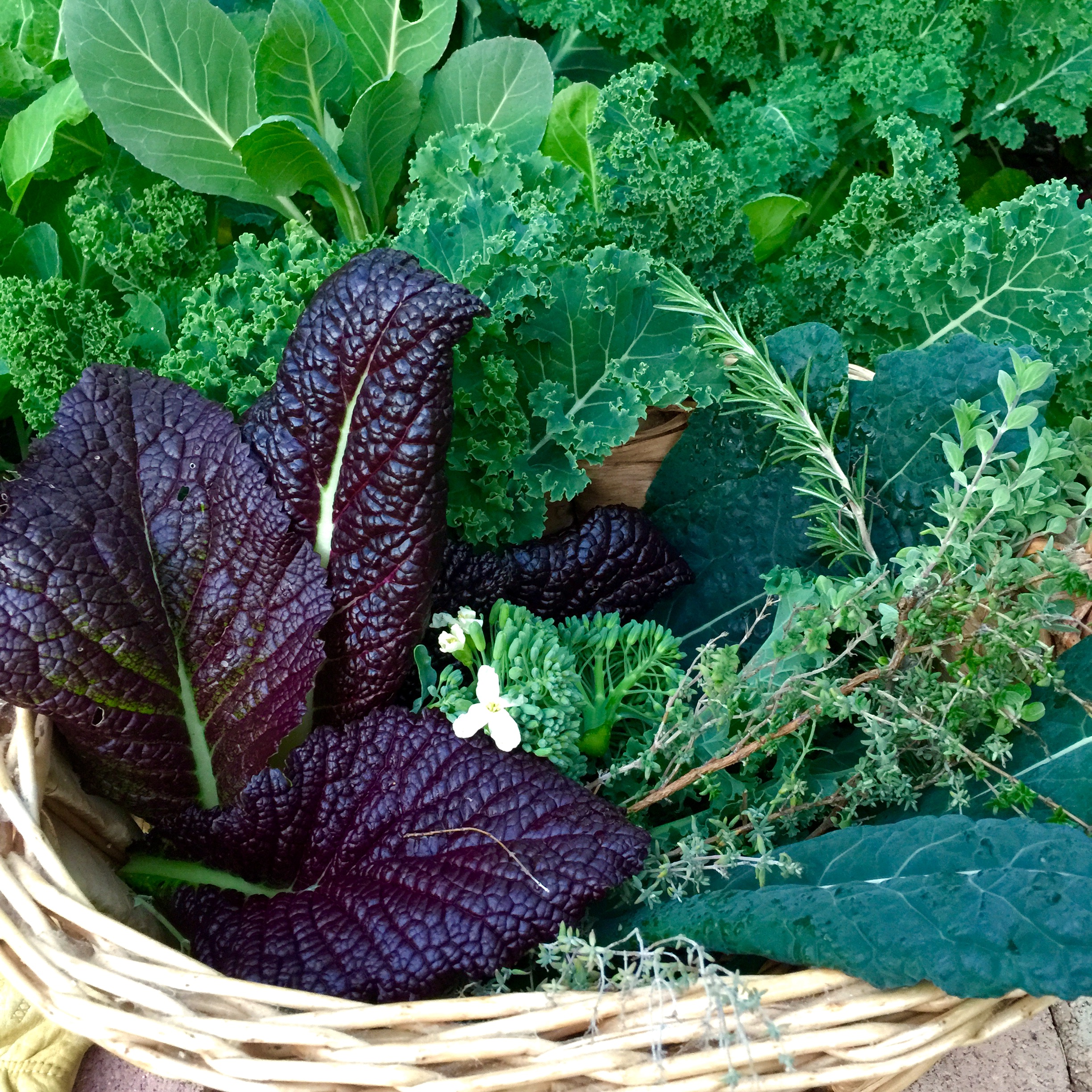
New Year’s Harvest (Nero di Toscano/Lacinato Kale, Giant Red Mustard Greens, Green Lance Kale Florets, Collard Greens, Herbs–Rosemary, Mexican Oregano, and Thyme.) © 2015 Kiandra Jimenez
New Year’s Day is steeped with legend, tradition, and history. It is like the pricked mustard leaf. With bravado we bring it in amongst loud neon signs, merlot nights. Everything is slightly sweet, crisp in the midnight air, hints of bitterness may linger if the passing year was particularly difficult, but nothing in the falling confetti speaks of the bites next year will hold. We are none the wiser of how we’ll grow or fail, if we’ll surrender or stiffen, if we’ll soar or resist success—however we define it.
But, what we do know is who we are, who we’ve been, and who we want to become. We know this by the stories we tell, the image-memories we carry around with us, for miles over our lifetime. Who are we? Who are we a part of? How do we honor their lives, our lives? And, how can we live outside of our own skin?
My answer is Nature, story, food, and family folktales and lore; what’s your answer?
New Year’s Black Eyed Peas, or Hoppin’ John
1 lb. black eyed peas, soaked overnight
1 medium, mild onion (or 3 stalks of celery), diced
1 bell pepper, diced (red or green—I prefer red, but green is traditional)
1 lb. of bacon (turkey or pork), cut into pieces (you can substitute a couple of ham hocks, or a smoked turkey leg for the bacon, but you don’t need both bacon and hocks/smoked turkey)
1 qt. of broth (chicken or vegetable), plus extra water
1 piece of Kombu* (optional)
1 clove of garlic (optional)
Salt and Pepper, to taste
1. The day before you plan to eat your peas, sort through the peas, pulling out any rocks, debris, or bad peas. Cover peas with cold water in a large bowl, cover, and soak overnight. In the morning, drain the water from the peas, and rinse well under cool water. Set aside to drain.
2. While the peas are draining, cook bacon pieces over medium-high heat until they release oil. If you are using turkey bacon, you may have to add a bit of oil to the pan. About halfway through cooking, add the onions (or celery) and peppers, cooking them till they are soft, and onions are translucent. Add the garlic, if using, turn down the heat to make sure it does not brown. Alternatively, if you are not using bacon, put a little oil in the pot and sweat the vegetables in the same manner.
3. When the vegetables are done, add the peas, Kombu, ham hock or smoked turkey (if you are using them), and stock to the pot. Add extra water to fill the pot to desired consistency. If you like your peas soupy, add extra water, if you prefer them thicker, less water. Make sure there is lots of water, as some of the water will cook off.
4. Turn the heat to high and bring to a boil. Once boiling, cover, turn the heat down to medium-low and let the beans simmer until soft, about 1 – 1 ½ hours**, stirring from time to time. Season peas with salt and pepper to taste, about halfway through cooking, and again at serving, if necessary.
Serve over rice, with a side of greens, candied yams, cornbread, and a protein of your choice.
Vegetarian/Vegan New Year’s Black Eyed Peas or Hoppin’ John:
To make vegan, omit the meat and proceed with recipe, using vegetable stock. To deepen the flavor, add hickory liquid smoke, and soy sauce/tamari/liquid aminos to the stock about thirty minutes into cooking. Additional flavor and texture can be added with imitation bacon bits.
*Kombu is a sea green you can find in natural stores, or online. It helps to tenderize the beans, aid digestion by minimizing gas, and seasons the broth with an umami, savory flavor. It is salty like the sea, high in minerals, but lacks any fishy flavors. This isn’t traditional, but it does enhance the recipe, in my opinion.
**I’ve found cooking time can vary widely, depending on the age of the peas. Begin checking at about an hour in, and every fifteen minutes until done.