
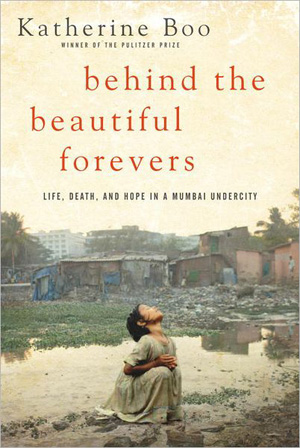
Writers Read: Behind the Beautiful Forevers by Katherine Boo
 Behind the Beautiful Forevers, Katherine Boo, the Pulitzer Prize-winning author, chronicles the stories of peoples living in Annawadi, a slum on the outskirts of the airport in Mumbai, India. Between 2007-2011, Boo interviewed 168 people and reviewed over 3,000 public records with the help of translators. She did so in order to answer some pretty big questions: What does it take to get out of poverty? What types of opportunities are afforded the poor in globalized India? How can one become less poor? And why don’t more poor societies implode? Poverty. Corruption and opportunity. Education. Racism. Sexism. Despair and hope. These are some of the themes Boo tackles. In the slum of Annawadi, we learn that the poor do not unite against the privileged but rather compete against one another for scarce resources. To the wealthy citizens of Mumbai, the slum dwellers are like parasites—feeding off the scraps that even the rich don’t want to share with the poor. But who are the real parasites? Maybe it is the rich feeding off the cheap labor of the poor, which allows for their lavish lifestyles. In this meticulously researched book of nonfiction, which reads like a novel, Boo tells us who moves up in Annawadi and who does not.
The intersection of corruption and opportunity is interesting in Boo’s coverage. There is Asha, an opportunistic, ambitious woman who wants something better, but in order to attain that, she must exploit other slum-dwellers: “And when she had real control over the slum, she could create problems in order to fix them—a profitable sequence she’d learned by studying the Corporator” (20). Because of her ruthlessness, she moves up from a farmer to a teacher to a politician. Boo makes this paradox clear to us when she writes: “…corruption was one of the genuine opportunities that remained” (28). Like Asha, Sunil begins to thrive when he transitions from scavenger to thief. One of the most beautiful moments in the book is when Sunil is standing atop the roof of one of the construction sites he is robbing: “For Sunil, seeing the people from above made him feel close to them” (197). Corruption is everywhere in Annawadi—from the World Vision social worker who runs away with money meant for a new tap to the police, investigators, and even doctors who exploit the poor for personal gain.
In the slum of Annawadi, we learn that the poor do not unite against the privileged but rather compete against one another for scarce resources.
Corruption, though, is not the only way to move up in the slums. She writes, “As every slum dweller knew, there were three main ways out of poverty: finding an entrepreneurial niche, as the Husains had found in garbage; politics and corruption, in which Asha had placed her hopes; and education” (62). Even though “…spreading educational opportunity was not among the Indian government’s strong suits…” (13), Manju goes to college and hopes this will be her way out of the slums.
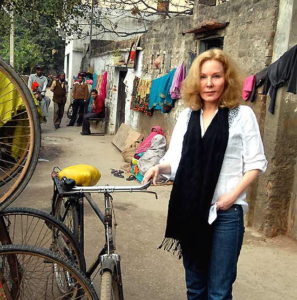 Prejudice pervades Indian culture, as Boo teaches us, and “India still makes a person know his place” (15). “Muslims,” like the Husains, “were still excluded from many good jobs” (13) and anti-migrant campaigns trapped many in poverty. Even in the boy’s detention center where Abdul goes after the burning of One-Leg, Boo tells us that “Muslims were overrepresented in the justice system” (127), something akin to the overrepresentation of African Americans in the U.S. justice system. Likewise, sexism is just another flavor of prejudice in India. Because she’s a girl, Meena, Manju’s friend, is not allowed to learn English as it “reduced a girl’s compliancy.” Kehkashan, Abdul’s sister, runs away from an arranged marriage in which her husband loves another woman. And Zehrunisia returns to purdah in order to protect herself, after her family is imprisoned. It is because of this oppression that Asha’s corrupt rise in power is both admirable and despicable.
But throughout the despair—throughout the murders of scavengers and thieves, the suicides of Annawadi women, the deaths of boys addicted to Eraz-X, there is hope. Not even TB, lakes of sewage, rat-infested shacks, and hunger can suppress that hope. Though not everyone achieves it, “everyone in Annawadi wanted one of the life-changing miracles that were said to happen in New India” (20). Paradoxically, Fatima, after self-immolating, finally feels like she matters when she is in the hospital. Abdul has hope when he is sent to the boy’s detention center and is inspired by the Master. And even the poorest Indians have faith in reforming a broken Indian government.
Boo is a masterful writer, and how she organizes the book is impressive. First, she sets the stage and introduces us to the main characters, both undercitizens and setting: Annawadi, Asha, Sunil, and Manju. The plot does not really begin until page 89 when the Husains begin to renovate their shack with their new money, and Fatima becomes angry and annoyed by the racket. After a verbal fight, Fatima burns herself and falsely blames the Husains. Boo provides resolution as the Husains are found not guilty and others, such as Meena, escape through suicide, Asha rises up through further corruption, and Sunil, who had begun thieving, stops and returns to something more respectable: scavenging.
Ultimately, for Boo, this outstanding reportage is an act of social justice. Poor lives do matter, and hope does exist—even in the most forgotten, lowly slums of India—a country where one third of the world’s poor live.
Throughout it all, Boo crafts vivid, engaging language, with well-crafted sentences such as: “ [the] Sewage and sickness look like life in Annawadi” (5). Boo’s description of rats that bite Sunil and his sister are haunting and grotesque: “…while they slept, and the bites had turned to head boils. But she had recently become a baldie, because her boils had erupted with worms” (194). Such devastating descriptions are juxtaposed with something more hopeful—like when Abdul believes he can be better than what he is. She writes, “Ice was distinct from and in his view, better than what it was made of. He wanted to be better than what he was made of” (218). Boo’s prose even becomes poetic as she describes the rain: “Now it poured, a stinging rain. On the high grounds of the liquid city, rich people spoke of the romance of the monsoon: the languorous sex, retail therapy…At Annawadi, the sewage lake crept forward like a living thing. Sick water buffalo nosed for food” (24). She also makes ample use of metaphors and similes. In describing the scavengers, she writes: “Each evening, they returned down the slum road with gunny sacks of garbage on their backs, like a procession of broken-toothed, profit-minded Santas” (xii). Sunil’s eyes were “black as keyholes” (33). And on the night that Fatima burned herself, “the sky above the maidan [was] purple as a bruise” (98).
Katherine Boo’s Behind the Beautiful Forevers represents some of the finest in Creative Nonfiction writing. I am in awe of her social justice mission, her exhaustive research, her use of setting and weather as character, her organization (though slow at first), her meditation on themes such as poverty, corruption, hope, and prejudice, and her dedication to poetic, economical language. Ultimately, for Boo, this outstanding reportage is an act of social justice. Poor lives do matter, and hope does exist—even in the most forgotten, lowly slums of India—a country where one third of the world’s poor live. Even though it is hard for poor people to do good in a place that seems so bad, poverty can be alleviated and social and political policies improve when we better understand ordinary lives—like the peoples of Annawadi.
Works Cited
Boo, Katherine. Behind the Beautiful Forevers. New York: Random House, 2014. Print.

Teri Fuller is a student of Creative Nonfiction at Antioch University in Los Angeles, an English Professor at Waubonsee Community College in Illinois, a breast cancer survivor and advocate, a Consumer Reviewer for the Department of Defense’s Breast Cancer Research Program, and a mother to her dear daughter, Lily. She is the recipient of the One Hundred Award sponsored by Mass General Cancer Center, and she has written much about her life during and since her breast cancer diagnosis