
Trigger warning: eating disorders.
A few years ago, I worked with a girl who said she ate ramen noodles in college so she didn’t have to ask her parents for money. “I struggled too,” she said, and I wanted to scream at her because what she failed to realize was that her parents had money to lend her. She had someone to ask for help. In her cubicle across from me, she fidgeted with her manicured fingers, stroked her blonde hair. She wore black clothes to create the illusion, she said, of being thinner, and I thought with a rumbling in my gut, close to rage, that this woman had never in her life been hungry.
At this time, I was more than 30 pounds overweight. I stopped weighing myself after I saw a chart at the doctor’s office that said I was obese, but I know I gained more weight after that. In January 2020, Dallas Yoga Magazine published an article I wrote called “Secrets of a Yogi: Losing & Keeping 40 Pounds Off.” At that point, I was in yoga teacher training, I worked out for an hour almost every day, and I was vegan. As the idiom suggests, my weight loss was a journey, indeed. Though I do write about the habits that led to my greatest weight gain, I don’t mention that this fluctuation has been going on for my entire life.
I do not write about where the hunger comes from.
***
When I was about six or seven, my mom and I dug in the couch cushions for change. We walked to a gas station to buy 50-cent powdered donuts. We ate them on the curb outside the door, like people whose gaze you avoid when they approach your car window at stoplights.
I remember being one of three open mouths standing in front of my grandmother as she sat in her tattered recliner, a whole gallon of ice cream in her lap, taking a single spoon and dolling out morsels for us one at a time. This was our dinner.
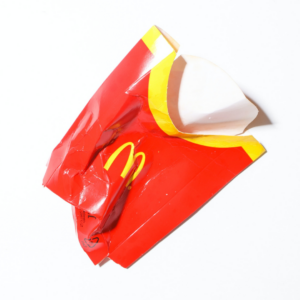
My mom and I lived with my grandmother, as did my uncle and his two sons. The boys and I ate raw hotdogs, bologna, plain white bread. On rare occasions, we’d have spaghetti for dinner. McDonald’s was cheap enough for all of us to get something, but it was a close call. Once, my younger cousin dropped his hamburger on the floor, the mystery meat greasing into the carpet, stained with cat piss and polked with cigarette burns. He cried. My other cousin and I were horrified. We wanted to sooth him but didn’t want to give up what little we had. I bent down and picked up the patty, dusted it off, blew on it as I had seen my grandmother do, and offered it to him. “See? It’s OK. It’s still good.” We put it back between the buns, and my cousin ate it. It still tasted good. After just a few bites, his cheeks were dry.
Was it ever any wonder that when we did have money, we bought food? Sure, you can buy a toy for two dollars, but why do that when you can make a babydoll out of toilet paper? You can spend the same amount of money and get five savory, juicy items at Jack in the Box, totaling over 3,000 calories.
Nutritious food was scarce, but calories were plentiful. A scarcity mindset propels you to keep eating — because when will you eat again? And also, what other opportunities do you have to feel this good? If you want to just forget, for a moment, that your electric bill will be late this month, why not enjoy an entire pizza by yourself? The endorphins from fast food and sugar feel pretty close to getting drunk and popping pills.
But being overweight is bad, and being an overweight poor girl was an abomination. Women are only seen as people if they’re desirable. Society tells us that desirability is something you buy, something to execute through makeup, designer clothes, slim bodies attained through expensive workout regimens and diets. Even without taking food insecurity into account, societal beauty is nearly unattainable for poor women, and not meeting it means being overlooked, unseen. They don’t exist unless a man wants to sleep with them. Poor women learn to rely on the approval of poor men, to nurture a sense of general being, until they are financially tied to him, until they are convinced that being beautiful will boost their overall wellbeing. Being seen is a greater currency than survival. It’s easier to forfeit nutrients than the perception of love and belonging.
Would it surprise you, reader, to learn that my mother bounced from marriage to marriage before moving back in with her mom? Would it surprise you that the men she dated hurt her daughters? Was it any wonder she was overweight?
When I was a kid, I’d rest my head against her stomach, like she was a body pillow made just for me. But soon I learned that my mother wasn’t as comfortable with her body. I sang down the hallway after her once, “Mommy’s got a biiiiig butt. Mommy’s got a biiiiig butt,” and she turned around to tell me how much it hurt her feelings. I warned my sister, who was visiting for the summer, not to leave her candy bar unattended because Mommy would just eat it. Overhearing me, my mom didn’t speak to me for the rest of the day.
Besides my mother’s preoccupation with sugar, she also had a few disorders weighing her down: Sleep apnea robbed her of rest each night, causing her to doze off at her desk at work, and untreated bipolar disorder made it difficult for her to manage her relationships. She would go through depressive waves that lasted months. There are entire years of my childhood when I do not remember my mother being awake. Sleep interrupted her meals, but her weight gain persisted. In her waking moments, she continued to eat cheap food, rich in salt, sugar, fat and endorphins, but more than anything, it was cortisol that tied her to obesity. Cortisol, the stress hormone, turns obesity into a safety net. Your body plans ahead for the times when you have nothing to eat. But the thing is: there’s always something to eat, when 50-cent powdered donuts that never expire. The body saves fat while you keep spending money.
My mom’s disorders made it difficult for her to hold down a job, which added more cortisol, which added more weight. Is it a coincidence that a cycle is round?
She had a picture of herself when she was slim enough to shop outside of the plus-sized sections at Walmart. I kept it because it gave me hope that I could grow up to be beautiful, that one day I could be seen. I didn’t know at the time that my mom was only able to get so skinny by doing ecstasy every day to curb her appetite.
I ate nearly as much as she did but I managed to keep most of the weight off by pacing: My anxiety told me to move-move-move, so I could feel like I was doing something to help myself, do something to not be sleeping on a bare mattress on the floor in a living room I shared with four others. The others escaped through TV, movies, video games. They were content to sit. I needed to do something, so I walked back and forth and back and forth and back and forth. It drove my uncle crazy, the constant movement in his peripheral vision, but I wasn’t hurting anyone, and I was out of trouble and occupied, so my mom let me do it: pace, pace, pace. Though I’ve always teetered between “technically not overweight” and “technically overweight,” I was the slimmest member of my family. The next person in line was 30 pounds overweight. I had family members who were so obese, they were immobile. The only time I saw my grandmother leave her bed was to use the bathroom.
Pacing kept me slimmer than most of my family members, but I still had, according to society, a distorted view of my body. I believed that because I wasn’t big, I was small. I made a friend when I was 10 who was 80 pounds, a girl with her own set of body issues I couldn’t understand. People made fun of her for being flat-chested, lacking hips, but I wanted her bony wrists and ankles, her slender fingers and toes. Why didn’t I look like her? As I consumed more media, I noticed that more and more of the women on TV looked like my friend than they looked like me.
I started watching my friend to see what she did differently. Hanging out with her once, I was amazed at her ability to eat a few bites of ice cream and then save the rest of the pint for later. Still, she seemed to be eating all the time, an activity I couldn’t enjoy without being squeezed by my clothes. I was horrified once to find that a bubble of skin poked through a hole in the inseam of my pants. The constant rubbing of my thighs eroded the fabric. Gone were the days of holey knees from tumbles to the concrete; the very shape of my body betrayed me by letting in a draft.
How much of my body was inherited and how much was passed down like a family heirloom?
In high school, I tried my best to eat less, not healthier. I counted the number of chews before swallowing to savor it and trick myself into eating less, a trick I read about in Shape Magazine. I got to a point where the food I was chewing would naturally travel to the back of my throat and I would, with a tensing of my tonsils, thrust the mush back into my mouth. My throat became raw this way, but I lost weight. People made comments about how skinny my waist was. I remember an entire summer where I just ate cookies, exactly three M&M cookies for the whole day. Even when I was “technically not underweight,” I wasn’t skinny. I was still soft and round, and I hated that I had to work so hard to look like the women on TV when other girls, like my friend, could eat whatever they wanted and not gain a pound.
I relished in my stomach’s symphony, the pain that came because of my own intention, not circumstance. I was in control. But I could only maintain this regimented eating for so long, and when I gave in to the cravings, I gained the weight back and more. When I was alone, I’d chew Kit-Kat bars and spit out the frothy chocolate into a cup. I started throwing up my food until I got discouraged by how little I could expel. I had hoped it would be a way to un-eat the calories I consumed, but instead, it was a punishment for overeating. I stopped purging after trying it about five times. I wanted to be thin and I wanted to eat, but I didn’t hate my body enough to keep putting myself through the gagging, the sweating, the tears.
I don’t want to do that to myself anymore.
***
Everyone has been talking about the weight they’ve gained in quarantine, about how they’ve been eating out of boredom, but I don’t think that’s the reason people are adding on the pounds. It’s that people are afraid. They don’t know what’s going to happen next. They don’t know if they’ll get to keep their jobs. They’re not sure when their next meal will come.
In “Secrets of a Yogi: Losing & Keeping 40 Pounds Off,” I say that I didn’t lose a single pound without first learning to love myself. This is true to a large extent. I learned to accept my body at each stage, learned to incorporate more physical activity into my daily life instead of doing what I usually did: hit the gym until I hurt myself, until I punished myself for being curvy.
But I’ve gained 20 pounds since the start of quarantine. I don’t fit in my jeans anymore. I can only fit in my tights, and even still, a softness around my ribs spills over the tops. It’s easy to look at your body with love if you feel like you’re on a path toward a particular beauty standard, but how are you supposed to love yourself if you’re moving away from it? How are you supposed to love yourself if you’re regressing and repeating the same patterns? It’s hard to love your body when you’ve been bred to believe it is merely a vehicle for survival.
I’m trying to stop pacing: seeing my life as a straight line, a connection from points labeled “bad” and “good,” a perception that makes it easy for me to beat myself up for backsliding. I’m learning that we orbit certain lessons in our lives; we come back to them, again and again, to see them from new perspectives, to learn a part of the lesson we didn’t consume before. And an orbit is a kind of cycle, isn’t it? It’s another curve in my life I’m learning to accept.

Amanda Woodard is a freelance poet, essayist and ghostwriter, and an MFA candidate at Antioch University. She studied Social Science and Journalism at the University of North Texas and attended writing workshops at the Mayborn Literary Nonfiction Conference and Writing Workshops Dallas. Her work has been performed in Oral Fixation and published in Ten Spurs, eris & eros and FlashFlood.