Litdish: Ashley Lumpkin, Poet
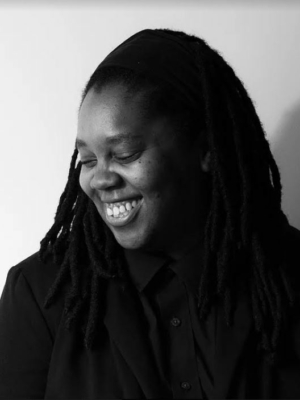 Ashley Lumpkin has been writing since she was seven. She is a poet and started doing slam poetry performance in 2010. She has four poetry collections and a new creative nonfiction collection called I Hate You All Equally. She has participated as a competing member of the Scuppernong Slammers, Piedmont SLAM, and the Bull City Slam Team. Her goal in her work is to blur the lines between work that’s presented on stage and work that’s presented on the page.
1. You have a new book called I Hate You All Equally. Is there any context you would like to give about this new work?
Okay, so I Hate You All Equally is actually—it’s my first book that’s not a collection of poems. I’m a high school math teacher as well, and I’ve been doing that for eleven years… One of the things I have been doing since the very beginning of my teaching career is kind of keeping a log of some of the crazy things my kids say in class. And so it’s just a collection of conversations I’ve had with students. Some of them hilarious, some of them more poignant, and I asked my kids, my pre-calc class from last year, what I should call it… So we decided on I Hate You All Equally, which is what I tell them, my pre-calc class in particular, they liked to fight last year over who was my favorite, and so I shut down that argument by saying, “I have no favorites. I hate you all equally.”
2. I know you have a love for mathematics. How do math and poetry connect for you?
Okay, so there are times when I approach word choice the way you might approach solving an equation, particularly if it’s a poem that I know I’m going to be performing a lot. If it’s a poem that’s on the page then, like, meaning is kind of the paramount consideration, but if you are writing a poem for performance then there are more variables to consider. Meaning, the rhythm within the line, the number of syllables of that word, where the stress of the syllable is in that word, and so all those things are variables, so word choice tends to be kind of an equation I have to solve sometimes.
3. As an accomplished slam poet, how does the process or feeling of speaking versus writing poetry play out for you?
The biggest distinction for me between what happens on the page versus what happens when you’re in front of an audience is that if I’m reading something and I don’t understand it, then I can go back to the line before and try again as many times as I need to. But if I’m talking in front of an audience, then they need to be able to understand what I’m saying as I’m saying it in context with everything I said before. Some of the more sonic literary devices come into play a lot more because it creates expectation for what you might say next. It’s a tiny thing, but it creates expectation of the audience, so they can track you a little bit easier. My poems never tend to be linear that I’m going to perform on stage… One of the ways that I think performing informs what I do is I feel like I pay a lot more attention to enjambment than some other writers might and how the shape of a thing affects how the eyes travel, and I agonize so much about the way the thing looks on the page as it compares to the way I say it out loud.
4. Do you have a ritual for writing? May we have a glimpse of it?
So, all my work starts on paper with the pen. I tend to think—I tend to start with the middle of poems and work out, as opposed to starting from top to bottom, but none of that speaks to ritual. There’s a song; my brother wrote this song. It’s called “Reverse Piano Revenge,” and I listen to it on repeat while I’m writing. Either that song or—Hidden Beach did this series of albums called Unwrapped, and it’s like rap songs without lyrics, and there’s like a saxophonist, a cellist, a bass player, a violinist that sort of freestyle over these beats, and so I listen to “Forgot About Dre,” so those two songs on repeat. I cannot write when it’s quiet because then I think too much. What will happen is that I’ll start editing instead of trying to get it all out if it’s too quiet, but if it has words in it, those words will tend to show up in what I’m writing, and that’s not cool. Those two songs I know so well that they can fade into the background. I’ve tried to add other instrumentals, and it just doesn’t work for me. My brain starts focusing too much on what’s going on in the music. And I move around. I can’t sit still and write. I’ve got to be walking. I don’t know if I’m engaging an imaginary audience in the room, but I’ve just got to be moving. I think those are the only things I always do when I write.
5. You do a lot of work in the community like spearheading First Draft, which allows community members to read their works in progress. How does this work feed you?
I’ll speak to First Draft first. I think what has been true is that I’ve sort of been able to be a part of different subcommunities in the Greensboro arts scene, the Greensboro literary scene in particular, and I always talk a lot about how those different groups exist within their own silos and don’t interact—in ways that I think are really harmful to the craft of writing. First Draft is kind of my opportunity to put my money where my mouth is and, really, if I want us to be about different groups getting together, then where is the space that that can actually happen? The goal of First Draft is all genres, all experience levels, getting to share wherever they are in process with their piece. It’s a quarterly event. Two cycles ago, we had all high school-aged features, which was really exciting to get adults out, just for the purpose of hearing high school work. That was fantastic. The last go around, we had a lot of short stories, so that was exciting. So [it’s] just trying to get more people of different disciplines together in the same room. Because I think so much of my work is informed by my love of music, my love of theater, my love of dance, and all these other things. It’s like if you’re only kickin’ it with other poets, then I don’t want to hear your poems anymore after a certain point.
I also really like to participate with the Community Theatre of Greensboro just to feed my love of performance in a different way. That’s kind of it for literary, artsy-like work. And the other stuff is just trying to take care of people in a real way. At a certain point, I don’t care about your poems about domestic violence if you’re not volunteering at a shelter every now and again. That, too, is me putting my money where my mouth is. Not that I have money as a teacher and a poet, but that’s another conversation.
6. There’s the age-old question: If you could have dinner with any three people, living or dead, who would they be?
I feel like the Pentecostal in me has to say Jesus. That feels like a thing. Don’t write that down. Well, Nikky Finney has to be one. My grandma just ‘cause who else is going to cook? Right? And, oh, this is difficult. Those two people are staples, but now I’m thinking who can I bring in that’s really going to engage in a really spicy conversation with those two folks? Do I need a dude at the table? Because that feels lame. Michelle Obama. Only because I think it would be hilarious to hear the conversations that Helen Lumpkin has with Michelle Obama. Oh, I would pay money for that. My grandma passed away when I was fourteen, but she was the most wildly inappropriate and hilarious person at all times. It would be great. I would just laugh and eat macaroni for hours.
7. Your work covers a large scope from living in fear to religion to Southern cooking to the personas we wear. What ideas are driving your writing at the moment?
So, every single poem that I write is a love poem. I start from there always. I think one of the reasons that I use religion a lot is because, growing up, I absolutely loved my faith, so then reckoning with the inconsistencies in it was out of this deep love and respect for it. So it’s like here are these things I believe in my core but know cannot be true. I think the love of those things is what drives me. Right now, I’m working on a project called Disorder, and it is about navigating bipolar disorder and also taking a look at how mental illness in general, [but] that one in particular, shows up in media, how it shows up in artists communities. And again, that comes from a deep space of love because I know so many of my peers, so many of the people that I’m close to, that I love, struggle with mental illness in some capacity. So just reckoning with how that illness has shown up in my own life, how it’s shown up in the lives of people in my family, in my community, that’s kind of where my head is at these days.
8. What should we be reading right now?
Everyone should read A Million Little Pieces by James Frey. It’s a beautiful book. It’s a lie, and it’s awful that he’s a lying liar, but the book is so good. I think everybody needs to read more young adult fiction. I think the folks that are writing YA fiction in particular are so honest with kids in a way that we are not and really need to be. Shout out to Liz Acevedo. She wrote The Poet X and With the Fire on High. Also, real talk, there are so many young adult fiction authors who came out of the spoken word tradition, so Liz is one of them. Jason Reynolds is one of them. And just the way that they have grown accustomed to engaging audiences in sort of raw ways is the way they engage with young adult readers, and I think if more older folks read that work, honestly, I think it would crack open some things in themselves. I hope.
9. Do you have any advice for new writers?
My advice for younger writers, for any writer, is to write every day and to read every day. I think inspiration is a thing, but I also think there’s kind of an idea that you’ll be walking down the street and a breeze will hit the leaves in such a way that you’re overcome and have to write that down, which is not to say that can’t happen, and it totally does. But I also believe inspiration will meet you at the place where you become disciplined. I wake up at an ungodly hour every morning to write. And there are days when I’m literally just writing down, “This is stupid. I could go back to sleep. I don’t know why I’m still writing.” But then there are other days that inspiration meets me at three-thirty in the morning because that’s what time I’m at the page. And then to read a variety of genres. For a long time in my earlier writing stages, I was only reading poetry, but then my own work stagnated. I started reading fiction and essays and cookbooks and graphic novels and just anything that’s out there. So, read as much as you can every day.
10. What question do you wish I asked you?
So, I totally thought on the way up here that you were going to ask something about if I wanted to write full time. That’s what my brain prepared for. Do I want to write full time? God, no. I did take a year and a half off from teaching with this goal of “I’m going to write and perform and do the thing.” And about eight or nine months into it, I sat down and looked at the financials and was like, “Damn, I can do this. This could be my life.” But also, I was miserable because I love being in a classroom. I can’t imagine a day where I [wouldn’t] be teaching math to people who hate math. I think most creative folks are sold the idea that the dream is to do the creative thing as your full-time job, and for some people it is, but for some people, it’s not the dream and that has to be okay too.
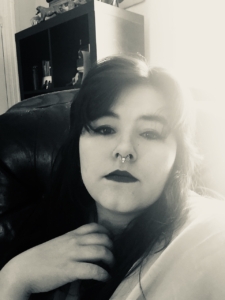
Molly is a writer whose fiction work focuses on femininity and liminality, often within the framework of mythologies. She currently lives in Greensboro, NC, where she is an active community member. She is an MFA candidate at Antioch University Los Angeles, where she works on the staff of Lunch Ticket as an assistant editor to flash prose and also assists with social media.