
Lunch Ticket
  • Current Issue
  • Archive
    • Issues Archive
      • Issue 28: Winter/Spring 2026
      • Issue 27: Summer/Fall 2025
      • Issue 26: Winter/Spring 2025
      • Issue 25: Summer/Fall 2024
      • Issue 24: Winter/Spring 2024
      • Issue 23: Summer/Fall 2023
      • Issue 22: Winter/Spring 2023
      • Issue 21: Summer/Fall 2022
      • Issue 20: Winter/Spring 2022
      • Issue 19: Summer/Fall 2021
      • Issue 18: Winter/Spring 2021
      • Issue 17: Summer/Fall 2020
      • Issue 16: Winter/Spring 2020
      • Issue 15: Summer/Fall 2019
      • Issue 14: Winter/Spring 2019
      • Issue 13: Summer/Fall 2018
      • Issue 12: Winter/Spring 2018
      • Issue 11: Summer/Fall 2017
      • Issue 10: Winter/Spring 2017
      • Issue 9: Summer/Fall 2016
      • Issue 8: Winter/Spring 2016
      • Issue 7: Summer/Fall 2015
      • Issue 6: Winter/Spring 2015
      • Issue 5: Summer/Fall 2014
      • Issue 4: Winter/Spring 2014
      • Issue 3: Summer/Fall 2013
      • Issue 2: Winter/Spring 2013
      • Issue 1: Spring 2012
    • Genre Archive
      • Creative Nonfiction
      • Essays
      • Fiction
      • Flash Prose
      • Interviews
      • Lunch Specials
      • Poetry
      • Translation
      • Visual Art
      • Young Adult
  • About
    • Mission Statement
    • Lunch Ticket Staff
      • Issue 28: Winter/Spring 2026
      • Issue 27: Summer/Fall 2025
      • Issue 26: Winter/Spring 2025
      • Issue 25: Summer/Fall 2024
      • Issue 24: Winter/Spring 2024
      • Issue 23: Summer/Fall 2023
      • Issue 22: Winter/Spring 2023
      • Issue 21: Summer/Fall 2022
      • Issue 20: Winter/Spring 2022
      • Issue 19: Summer/Fall 2021
      • Issue 18: Winter/Spring 2021
      • Issue 17: Summer/Fall 2020
      • Issue 16: Winter/Spring 2020
      • Issue 15: Summer/Fall 2019
      • Issue 14: Winter/Spring 2019
      • Issue 13: Summer/Fall 2018
      • Issue 12: Winter/Spring 2018
      • Issue 11: Summer/Fall 2017
      • Issue 10: Winter/Spring 2017
      • Issue 9: Summer/Fall 2016
      • Issue 8: Winter/Spring 2016
      • Issue 7: Summer/Fall 2015
      • Issue 6: Winter/Spring 2015
      • Issue 5: Summer/Fall 2014
      • Issue 4: Winter/Spring 2014
      • Issue 3: Summer/Fall 2013
      • Issue 2: Winter/Spring 2013
      • Issue 1: Spring 2012
    • Achievements
    • Community
    • Contact
  • Weekly Content
    • Friday Lunch Blog
    • Midnight Snack
    • Amuse-Bouche
    • School Lunch
  • Contests
    • Diana Woods Award in CNF
      • Issue 28: Winter/Spring 2026
      • Issue 27: Summer/Fall 2025
      • Issue 26: Winter/Spring 2025
      • Issue 25: Summer/Fall 2024
      • Issue 24: Winter/Spring 2024
      • Issue 23: Summer/Fall 2023
      • Issue 22: Winter/Spring 2023
      • Issue 21: Summer/Fall 2022
      • Issue 20: Winter/Spring 2022
      • Issue 19: Summer/Fall 2021
      • Issue 18: Winter/Spring 2021
      • Issue 17: Summer/Fall 2020
      • Issue 16: Winter/Spring 2020
      • Issue 15: Summer/Fall 2019
      • Issue 14: Winter/Spring 2019
      • Issue 13: Summer/Fall 2018
      • Issue 12: Winter/Spring 2018
      • Issue 11: Summer/Fall 2017
      • Issue 10: Winter/Spring 2017
      • Issue 9: Summer/Fall 2016
      • Issue 8: Winter/Spring 2016
      • Issue 7: Summer/Fall 2015
      • Issue 6: Winter/Spring 2015
      • Issue 5: Summer/Fall 2014
      • Issue 4: Winter/Spring 2014
      • Issue 3: Summer/Fall 2013
    • Gabo Prize in Translation
      • Issue 28: Winter/Spring 2026
      • Issue 27: Summer/Fall 2025
      • Issue 26: Winter/Spring 2025
      • Issue 25: Summer/Fall 2024
      • Issue 24: Winter/Spring 2024
      • Issue 23: Summer/Fall 2023
      • Issue 22: Winter/Spring 2023
      • Issue 21: Summer/Fall 2022
      • Issue 20: Winter/Spring 2022
      • Issue 19: Summer/Fall 2021
      • Issue 18: Winter/Spring 2021
      • Issue 17: Summer/Fall 2020
      • Issue 16: Winter/Spring 2020
      • Issue 15: Summer/Fall 2019
      • Issue 14: Winter/Spring 2019
      • Issue 13: Summer/Fall 2018
      • Issue 12: Winter/Spring 2018
      • Issue 11: Summer/Fall 2017
      • Issue 10: Winter/Spring 2017
      • Issue 9: Summer/Fall 2016
      • Issue 8: Winter/Spring 2016
      • Issue 7: Summer/Fall 2015
      • Issue 6: Winter/Spring 2015
    • Twitter Poetry Contest
      • 2021 Winners
      • 2020 Winners
      • 2019 Winners
  • Submissions
  • Click to open the search input field Click to open the search input field Search
  • Menu Menu
  • Link to Facebook
  • Link to Instagram
  • Link to X

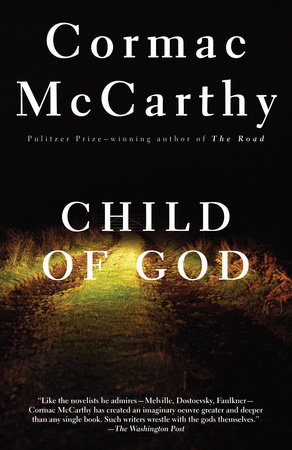
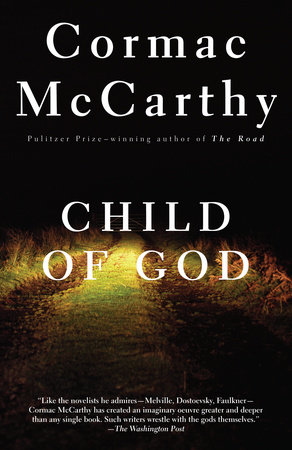
Writers Read: Child of God by Cormac McCarthy
July 31, 2017/in Amuse-Bouche, Amuse-Bouche 2017 / Edmond Stevens

Cormac McCarthy’s third novel Child of God, based loosely on an infamous murder in Sevier County, Tennessee, portrays a cycle of extreme isolation, perversity, and violence as representative of the natural human experience. The novel tells the story of Lester Ballard, “a child of God much like yourself perhaps,” who, facing a series of unfortunate circumstances beginning with his eviction from his home, descends into the limits of desecration, and literally into the depths of the earth.

McCarthy reveals his worldview in exchanges of dialogue, such as this conversation between Deputy Fate Turner and a local old timer:

“You think people was meaner then than they are now?”

“No,” he said. “I don’t. I think people are the same from the day God first made one.”

McCarthy always leaves subtle clues for his readers and demands character names receive due attention, and Child of God is no different. The naming of the sheriff seems a curious choice because, like Deputy Ed Tom Bell in McCarthy’s No Country for Old Men, the lawman is no “turner of fates,” unable to bend the course of evil but only able to identify the victims and inventory the evidence.

By portraying Lester as a tragic character instead of merely an instrument of evil, McCarthy pushes the limits of propriety—murder, pedophilia, necrophilia. He paints a portrait of a troubled individual faced with morbid images throughout his life. Lester is orphaned: first his mother abandons the home, and then, as a young boy, he discovers his father’s body, grossly disfigured from the father having committed suicide by hanging. So begins Lester’s fascination with the grotesquery of death. Rejected in more conventional interactions, he finds that he is only able to achieve intimacy and fulfillment via necrophilia.

McCarthy’s obsession with death, or at least the ritualization of death, is itself rendered with what one could describe as literary necrophilia. Death becomes a ritual of courtship for Lester. McCarthy’s description of the execution of two murderers portrays the public event as something of a civic celebration. In another sequence, Lester recalls the death of a wild boar, taken down by dogs, with a balletic verve, describing the “lovely blood” as the boar spirals into death.
Cormac McCarthy by Derek Shapton

McCarthy’s style is minimalist and completely removed of excess and decoration, both in terms of grammar and punctuation. He experiments with an unfulfilled narrative trope, evidenced when he reverts to a third person narrative in the voice of an unnamed member of his community. Here and in subsequent work, McCarthy seems to be unable to separate himself from Old Testament themes: catastrophic flood, blood sacrifice, revelation in fire, then later and more evidently in the Biblical language of Blood Meridian.

Child of God adds to McCarthy’s canon of depravity and darkness, coupled with the thesis that humanity is dark and prone to great, catastrophic evil. On the other hand, in McCarthy’s view, nature is profoundly beautiful, as depicted in the touch of leaves and fronds upon Lester’s face as he escapes his cavernous underworld, a suggestion of benediction and peace with his deplorable acts. Ultimately, having surrendered himself to a mental asylum (“I’m supposed to be here”), when Lester dies, his body is consigned for dissection, as if clues to the evil in him can be interpreted, the way pathologists look for tumors and aneurisms to explain morbidity. Child of God demonstrates McCarthy’s view that nothing organic or occurring in nature can amount to the evil in humanity.

McCarthy, Cormac. Child of God. Random House, 1973.

Edmond Stevens first began writing for publication while in high school for his hometown Burlington Free Press. That led to positions with major New England newspapers and later The Los Angeles Daily News. Life in Los Angeles made for the irresistible transition to screenwriting. Edmond’s portfolio includes six made-for-TV movies and numerous network series. His most recent credit (2014) is Skating to New York, based on his novella. Teaching credentials include creating the screenwriting program at Utah’s Writers@Work, plus workshop appearances at Sherwood Oaks College, University of Utah, University of Southern California, Chicago Film Commission, and Sundance Institute.


https://lunchticket.org/wp-content/uploads/2017/07/9780679728740-1.jpeg 450 292 Edmond Stevens https://lunchticket.org/wp-content/uploads/2021/12/lunch-ticket-logo-white-text-only.png Edmond Stevens2017-07-31 11:26:502019-06-29 15:30:57Writers Read: Child of God by Cormac McCarthy

Amuse-Bouche Archive

  • 2025
  • 2024
  • 2023
  • 2022
  • 2021
  • 2020
  • 2019
  • 2018
  • 2017
  • 2016
  • 2015
  • 2014
  • 2013

Friday Lunch Blog

Friday Lunch! A serving of contemporary essays published the second Friday of every month.

Today’s course:

Being A Girl is Hard

November 28, 2025/in Blog / Shawn Elliott
Read more
https://lunchticket.org/wp-content/uploads/2025/11/Headshot_Shawn-Elliott_1500x2000.jpeg 2000 1500 Shawn Elliott https://lunchticket.org/wp-content/uploads/2021/12/lunch-ticket-logo-white-text-only.png Shawn Elliott2025-11-28 11:00:252025-12-11 17:48:50Being A Girl is Hard

Diagnosis: Persisted or Silent Inheritance

November 7, 2025/in Blog / Paula Williamson
Read more
https://lunchticket.org/wp-content/uploads/2025/12/Headshot_Paula-Williamson_1467x2000.jpg 2000 1467 Paula Williamson https://lunchticket.org/wp-content/uploads/2021/12/lunch-ticket-logo-white-text-only.png Paula Williamson2025-11-07 11:00:072025-12-11 17:48:51Diagnosis: Persisted or Silent Inheritance

The Queer Ultimatum Made Me Give My Own Ultimatum

September 26, 2025/in Blog / Lex Garcia
Read more
https://lunchticket.org/wp-content/uploads/2025/09/Garcia_Headshot.jpg 1088 960 Lex Garcia https://lunchticket.org/wp-content/uploads/2021/12/lunch-ticket-logo-white-text-only.png Lex Garcia2025-09-26 11:00:112025-09-24 11:22:02The Queer Ultimatum Made Me Give My Own Ultimatum

More Friday Lunch Blog »

Midnight Snack

Take a bite out of these late night obsessions.

Tonight’s bites:

The Lilac and The Housefly: A Tale of Tortured Romanticism

October 24, 2025/in Midnight Snack / Nikki Mae Howard
Read more
https://lunchticket.org/wp-content/uploads/2025/10/Headshot_Nikki-Howard_1770x2000.jpg 2000 1770 Nikki Mae Howard https://lunchticket.org/wp-content/uploads/2021/12/lunch-ticket-logo-white-text-only.png Nikki Mae Howard2025-10-24 23:55:032025-10-20 10:59:03The Lilac and The Housefly: A Tale of Tortured Romanticism

Dig Into Genre

May 23, 2025/in Midnight Snack / Lauren Howard
Read more
https://lunchticket.org/wp-content/uploads/2025/05/Lauren-Howard-credit-Terril-Neely-scaled-773x1030-1.jpg 1030 773 Lauren Howard https://lunchticket.org/wp-content/uploads/2021/12/lunch-ticket-logo-white-text-only.png Lauren Howard2025-05-23 23:59:492025-06-17 18:29:02Dig Into Genre

The dreams in which I’m (not) dying

April 25, 2025/in Midnight Snack / paparouna
Read more
https://lunchticket.org/wp-content/uploads/2025/04/paparouna-photo.jpeg 960 720 paparouna https://lunchticket.org/wp-content/uploads/2021/12/lunch-ticket-logo-white-text-only.png paparouna2025-04-25 23:55:312025-08-14 16:18:41The dreams in which I’m (not) dying

More Midnight Snacks »

School Lunch

An occasional Wednesday series dishing up today’s best youth writers.

Today’s slice:

I’ve Stayed in the Front Yard

May 12, 2021/in School Lunch, School Lunch 2021 / Brendan Nurczyk
Read more
https://lunchticket.org/wp-content/uploads/2021/05/SL-Insta-Brendan-Nurczyk-2.png 1500 1500 Brendan Nurczyk https://lunchticket.org/wp-content/uploads/2021/12/lunch-ticket-logo-white-text-only.png Brendan Nurczyk2021-05-12 10:18:392022-02-01 13:24:05I’ve Stayed in the Front Yard

A Communal Announcement

April 28, 2021/in School Lunch, School Lunch 2021 / Isabella Dail
Read more
https://lunchticket.org/wp-content/uploads/2021/04/SL-FB-Isabella-Dail.png 788 940 Isabella Dail https://lunchticket.org/wp-content/uploads/2021/12/lunch-ticket-logo-white-text-only.png Isabella Dail2021-04-28 11:34:132021-04-28 11:34:13A Communal Announcement

Seventeen

April 14, 2021/in School Lunch, School Lunch 2021 / Abigail E. Calimaran
Read more
https://lunchticket.org/wp-content/uploads/2021/04/SL-Insta-Abigail-E.-Calimaran.png 1080 1080 Abigail E. Calimaran https://lunchticket.org/wp-content/uploads/2021/12/lunch-ticket-logo-white-text-only.png Abigail E. Calimaran2021-04-14 11:22:062021-04-14 11:22:06Seventeen

More School Lunch »

Word From the Editor

Editing issue 28, I felt something similar to the way I feel near water: I dove into my own private world. The world above the surface kept roaring, of course. The notifications, deadlines, the constant noise was always there. But inside the work, inside these poems and stories and artwork, there was a quiet that felt entirely mine. A place where I could breathe differently.

More from the current editor »
Current Issue »

Connect With Us

lunchticket on facebooklunchticket on instaX
Submit to Lunch Ticket

A literary and art journal
from the MFA community at
Antioch University Los Angeles.

Get Your Ticket

We’ll keep you fed with great new writing, insightful interviews, and thought-provoking art, and promise with all our hearts never to share your info with anyone else.

Newsletter Signup
Copyright © 2012-2025 LunchTicket.org. All Rights Reserved. Web design and development by GoodWebWorks.
Scroll to top Scroll to top Scroll to top