
Lunch Ticket
  • Current Issue
  • Archive
    • Issues Archive
      • Issue 28: Winter/Spring 2026
      • Issue 27: Summer/Fall 2025
      • Issue 26: Winter/Spring 2025
      • Issue 25: Summer/Fall 2024
      • Issue 24: Winter/Spring 2024
      • Issue 23: Summer/Fall 2023
      • Issue 22: Winter/Spring 2023
      • Issue 21: Summer/Fall 2022
      • Issue 20: Winter/Spring 2022
      • Issue 19: Summer/Fall 2021
      • Issue 18: Winter/Spring 2021
      • Issue 17: Summer/Fall 2020
      • Issue 16: Winter/Spring 2020
      • Issue 15: Summer/Fall 2019
      • Issue 14: Winter/Spring 2019
      • Issue 13: Summer/Fall 2018
      • Issue 12: Winter/Spring 2018
      • Issue 11: Summer/Fall 2017
      • Issue 10: Winter/Spring 2017
      • Issue 9: Summer/Fall 2016
      • Issue 8: Winter/Spring 2016
      • Issue 7: Summer/Fall 2015
      • Issue 6: Winter/Spring 2015
      • Issue 5: Summer/Fall 2014
      • Issue 4: Winter/Spring 2014
      • Issue 3: Summer/Fall 2013
      • Issue 2: Winter/Spring 2013
      • Issue 1: Spring 2012
    • Genre Archive
      • Creative Nonfiction
      • Essays
      • Fiction
      • Flash Prose
      • Interviews
      • Lunch Specials
      • Poetry
      • Translation
      • Visual Art
      • Young Adult
  • About
    • Mission Statement
    • Lunch Ticket Staff
      • Issue 28: Winter/Spring 2026
      • Issue 27: Summer/Fall 2025
      • Issue 26: Winter/Spring 2025
      • Issue 25: Summer/Fall 2024
      • Issue 24: Winter/Spring 2024
      • Issue 23: Summer/Fall 2023
      • Issue 22: Winter/Spring 2023
      • Issue 21: Summer/Fall 2022
      • Issue 20: Winter/Spring 2022
      • Issue 19: Summer/Fall 2021
      • Issue 18: Winter/Spring 2021
      • Issue 17: Summer/Fall 2020
      • Issue 16: Winter/Spring 2020
      • Issue 15: Summer/Fall 2019
      • Issue 14: Winter/Spring 2019
      • Issue 13: Summer/Fall 2018
      • Issue 12: Winter/Spring 2018
      • Issue 11: Summer/Fall 2017
      • Issue 10: Winter/Spring 2017
      • Issue 9: Summer/Fall 2016
      • Issue 8: Winter/Spring 2016
      • Issue 7: Summer/Fall 2015
      • Issue 6: Winter/Spring 2015
      • Issue 5: Summer/Fall 2014
      • Issue 4: Winter/Spring 2014
      • Issue 3: Summer/Fall 2013
      • Issue 2: Winter/Spring 2013
      • Issue 1: Spring 2012
    • Achievements
    • Community
    • Contact
  • Weekly Content
    • Friday Lunch Blog
    • Midnight Snack
    • Amuse-Bouche
    • School Lunch
  • Contests
    • Diana Woods Award in CNF
      • Issue 28: Winter/Spring 2026
      • Issue 27: Summer/Fall 2025
      • Issue 26: Winter/Spring 2025
      • Issue 25: Summer/Fall 2024
      • Issue 24: Winter/Spring 2024
      • Issue 23: Summer/Fall 2023
      • Issue 22: Winter/Spring 2023
      • Issue 21: Summer/Fall 2022
      • Issue 20: Winter/Spring 2022
      • Issue 19: Summer/Fall 2021
      • Issue 18: Winter/Spring 2021
      • Issue 17: Summer/Fall 2020
      • Issue 16: Winter/Spring 2020
      • Issue 15: Summer/Fall 2019
      • Issue 14: Winter/Spring 2019
      • Issue 13: Summer/Fall 2018
      • Issue 12: Winter/Spring 2018
      • Issue 11: Summer/Fall 2017
      • Issue 10: Winter/Spring 2017
      • Issue 9: Summer/Fall 2016
      • Issue 8: Winter/Spring 2016
      • Issue 7: Summer/Fall 2015
      • Issue 6: Winter/Spring 2015
      • Issue 5: Summer/Fall 2014
      • Issue 4: Winter/Spring 2014
      • Issue 3: Summer/Fall 2013
    • Gabo Prize in Translation
      • Issue 28: Winter/Spring 2026
      • Issue 27: Summer/Fall 2025
      • Issue 26: Winter/Spring 2025
      • Issue 25: Summer/Fall 2024
      • Issue 24: Winter/Spring 2024
      • Issue 23: Summer/Fall 2023
      • Issue 22: Winter/Spring 2023
      • Issue 21: Summer/Fall 2022
      • Issue 20: Winter/Spring 2022
      • Issue 19: Summer/Fall 2021
      • Issue 18: Winter/Spring 2021
      • Issue 17: Summer/Fall 2020
      • Issue 16: Winter/Spring 2020
      • Issue 15: Summer/Fall 2019
      • Issue 14: Winter/Spring 2019
      • Issue 13: Summer/Fall 2018
      • Issue 12: Winter/Spring 2018
      • Issue 11: Summer/Fall 2017
      • Issue 10: Winter/Spring 2017
      • Issue 9: Summer/Fall 2016
      • Issue 8: Winter/Spring 2016
      • Issue 7: Summer/Fall 2015
      • Issue 6: Winter/Spring 2015
    • Twitter Poetry Contest
      • 2021 Winners
      • 2020 Winners
      • 2019 Winners
  • Submissions
  • Click to open the search input field Click to open the search input field Search
  • Menu Menu
  • Link to Facebook
  • Link to Instagram
  • Link to X

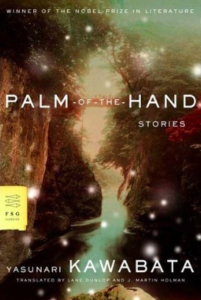
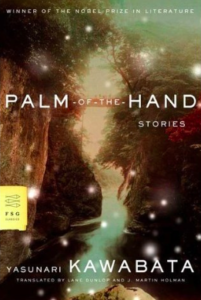
Writers Read: Palm-of-the-Hand Stories by Yasunari Kawabata
May 15, 2016/in Amuse-Bouche, Amuse-Bouche 2016 / Lauren Kinney

The palm-of-the-hand stories anthologized in this collection span decades of Yasunari Kawabata’s life, from 1923-1972, and far pre-date the recent moniker “flash fiction,” though they could be classified now using that label. Most of these stories are realistic, detailing families at home, strangers on the train, and past lovers’ meeting by chance. There are a few moments when the stories take fantastic or surreal turns, but on the whole they tend to have a mythological feel, perhaps because the stories often advance through large spans of time and end with a sentence that encapsulates the final movement of the story. Many of them feel like parables.

As I read, I made notes of which stories I thought worked well, and which didn’t float my aesthetic boat, and why. The stories I favored, tended to fall into two patterns: those that read like parables, and those that were more realistic fiction.

Those that assembled strange and lasting images in obscure parables included “The Maiden’s Prayers” (55-7), which follows villagers who glimpse a gravestone rolling down a hill as they try and fail to locate it, in the process sparking fires and ecstatic ceremony. This story has a tone like a parable but the narrator also seems like an actual person, though nondescript, as in this passage near the end of the story:

The villagers’ hearts were as bright as the sun as they laughed with all their might. Suddenly I stopped laughing and knelt at one of the gravestones illuminated by the fire of the burning grass.

“God, I am pure.”

But the laughter was so loud, I could not hear my own voice in my heart. The villagers laughed in harmony with the maidens until the hill was engulfed in a wave of laughter. (56-7)

Another parable-like story was “The Sparrow’s Matchmaking” (62-4). It opens with this sentence: “Long accustomed to a life of self-indulgent solitude, he began to yearn for the beauty of giving himself to others” (62). The story then proceeds in third-person narration with a chronology of thoughts and actions that feel true to life, revealing deep emotions behind family members’ actions as they toss coins and watch birds, and also conveying archetypal tension between solitude and sacrifices of love. “One Person’s Happiness” (69-71) does something similar in a story with more concrete characters: as the protagonist hears about a boy’s life of hardship, he weighs his decision to help the boy. This conveys his conviction that helping just one person makes life worthwhile. “Morning Nails” (83-4) explores vulnerability in love against a surreal domestic setting. “The Young Lady of Suruga” (85-7) is set on a particular train line, and achieves a strong sense of place.

This is one of the greatest benefits of reading flash fiction: for a writer looking to improve her craft, she can experience at an accelerated pace a diverse range of stories, which can help her gain insight on a wide range of craft considerations, as well as on her own personal literary preferences.
I enjoyed these parables and did not find their tone overly didactic. Though they were like parables, the characters seemed concrete, like real people. If the events conveyed seemed incidental, their effects on the characters in the stories were clear.

There were other stories that stuck with me that were not like parables, and which were more realistic. Some of my favorites were “At the Pawnshop” (121-4), “A Pet Dog’s Safe Birthing” (165-8), “Water” (171-2), and “Tabi” (178-80). These stories presented snapshots of events that are emotionally significant to narrators or protagonists: a desperate and ill man trying to scare up some credit at the pawnshop while another merchant pawns his capital to improve his public image; a married couple assisting in the birth of a litter of puppies, and then sitting down for coffee and a newspaper; a woman in a drought missing her husband and remembering the abundant water in her hometown; a woman who’s lost her sister, recalling the death of her teacher when she was a young teen. The realistic specificity of these stories makes these stories universal in a different way than the dreamy generality of the parables.

What I didn’t like were the stories that felt too episodic. “Toward Winter” (58-61) imbues a routine interaction, playing Go, with a mythical meaning, and then shifts into another story. As a reader I felt ricocheted about until an unsatisfying ending. The way the scenes were juxtaposed didn’t invest me in the story enough, since I didn’t have any other context for the characters therein—it seemed to be more about the author’s musings than about the reader’s experience. I normally consider myself to be very tolerant of cleverness in art, so it was strange for me to experience this aesthetic objection. This is one of the greatest benefits of reading flash fiction: for a writer looking to improve her craft, she can experience at an accelerated pace a diverse range of stories, which can help her gain insight on a wide range of craft considerations, as well as on her own personal literary preferences.

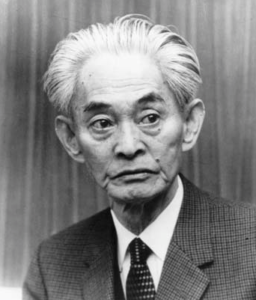
Author of Palm-of-the-Hand stories, Yasunari Kawabata

Author of Palm-of-the-Hand stories, Yasunari Kawabata

In leafing through this whole collection after reading it, I realized that some of my favorite stories in this collection involved children: “The Grasshopper and the Bell Cricket” (12-15) and “Yuriko” (88-9), for example. I’ve long been debating whether I want to write about and/or for children and adolescents, and some of the fiction I’m working on right now involves children as characters. Re-reading Kawabata’s stories involving children forced me to reflect on why writing about children appeals to me: they are wise in a different way than adults are. Their problems are less standardized, so writing about a child forces a writer to inhabit their world in its particularity. Children don’t have jobs or spouses, so their preoccupations in play and friendship have more unpredictable symbolic landscapes.
The short length of these stories helped me reflect on this literary interest more efficiently so I could articulate it. When you can hold a story in the palm of your hand, you can examine it from different angles, feel its weight, and you can slip it into your pocket to keep it if it pleases you. Or just as easily toss it over your shoulder.

Kawabata, Yasunari. Palm-of-the-Hand Stories. Trans. by Lane Dunlop and J. Martin Holman. San Francisco: North Point Press, 1988.
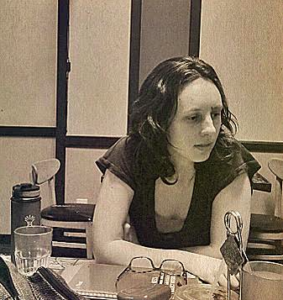
Lauren Kinney is a musician and writer in Los Angeles, where she is working on her MFA in Creative Writing at Antioch University. You can read her work in Drunk Monkeys, Queen Mob’s Tea House, and The Turnip Truck(s). Find her on Twitter @lauren_kinney, or learn more at her website www.laurenkinney.net.


https://lunchticket.org/wp-content/uploads/2016/05/Screen-Shot-2016-05-15-at-10.47.07-AM-201x300-1.png 300 201 Lauren Kinney https://lunchticket.org/wp-content/uploads/2021/12/lunch-ticket-logo-white-text-only.png Lauren Kinney2016-05-15 22:02:322019-08-11 17:41:05Writers Read: Palm-of-the-Hand Stories by Yasunari Kawabata

Amuse-Bouche Archive

  • 2026
  • 2025
  • 2024
  • 2023
  • 2022
  • 2021
  • 2020
  • 2019
  • 2018
  • 2017
  • 2016
  • 2015
  • 2014
  • 2013

Friday Lunch Blog

Friday Lunch! A serving of contemporary essays published the second Friday of every month.

Today’s course:

Being A Girl is Hard

November 28, 2025/in Blog / Shawn Elliott
Read more
https://lunchticket.org/wp-content/uploads/2025/11/Headshot_Shawn-Elliott_1500x2000.jpeg 2000 1500 Shawn Elliott https://lunchticket.org/wp-content/uploads/2021/12/lunch-ticket-logo-white-text-only.png Shawn Elliott2025-11-28 11:00:252025-12-11 17:48:50Being A Girl is Hard

Diagnosis: Persisted or Silent Inheritance

November 7, 2025/in Blog / Paula Williamson
Read more
https://lunchticket.org/wp-content/uploads/2025/12/Headshot_Paula-Williamson_1467x2000.jpg 2000 1467 Paula Williamson https://lunchticket.org/wp-content/uploads/2021/12/lunch-ticket-logo-white-text-only.png Paula Williamson2025-11-07 11:00:072025-12-11 17:48:51Diagnosis: Persisted or Silent Inheritance

The Queer Ultimatum Made Me Give My Own Ultimatum

September 26, 2025/in Blog / Lex Garcia
Read more
https://lunchticket.org/wp-content/uploads/2025/09/Garcia_Headshot.jpg 1088 960 Lex Garcia https://lunchticket.org/wp-content/uploads/2021/12/lunch-ticket-logo-white-text-only.png Lex Garcia2025-09-26 11:00:112025-09-24 11:22:02The Queer Ultimatum Made Me Give My Own Ultimatum

More Friday Lunch Blog »

Midnight Snack

Take a bite out of these late night obsessions.

Tonight’s bites:

The Lilac and The Housefly: A Tale of Tortured Romanticism

October 24, 2025/in Midnight Snack / Nikki Mae Howard
Read more
https://lunchticket.org/wp-content/uploads/2025/10/Headshot_Nikki-Howard_1770x2000.jpg 2000 1770 Nikki Mae Howard https://lunchticket.org/wp-content/uploads/2021/12/lunch-ticket-logo-white-text-only.png Nikki Mae Howard2025-10-24 23:55:032025-10-20 10:59:03The Lilac and The Housefly: A Tale of Tortured Romanticism

Dig Into Genre

May 23, 2025/in Midnight Snack / Lauren Howard
Read more
https://lunchticket.org/wp-content/uploads/2025/05/Lauren-Howard-credit-Terril-Neely-scaled-773x1030-1.jpg 1030 773 Lauren Howard https://lunchticket.org/wp-content/uploads/2021/12/lunch-ticket-logo-white-text-only.png Lauren Howard2025-05-23 23:59:492025-06-17 18:29:02Dig Into Genre

The dreams in which I’m (not) dying

April 25, 2025/in Midnight Snack / paparouna
Read more
https://lunchticket.org/wp-content/uploads/2025/04/paparouna-photo.jpeg 960 720 paparouna https://lunchticket.org/wp-content/uploads/2021/12/lunch-ticket-logo-white-text-only.png paparouna2025-04-25 23:55:312025-08-14 16:18:41The dreams in which I’m (not) dying

More Midnight Snacks »

School Lunch

An occasional Wednesday series dishing up today’s best youth writers.

Today’s slice:

I’ve Stayed in the Front Yard

May 12, 2021/in School Lunch, School Lunch 2021 / Brendan Nurczyk
Read more
https://lunchticket.org/wp-content/uploads/2021/05/SL-Insta-Brendan-Nurczyk-2.png 1500 1500 Brendan Nurczyk https://lunchticket.org/wp-content/uploads/2021/12/lunch-ticket-logo-white-text-only.png Brendan Nurczyk2021-05-12 10:18:392022-02-01 13:24:05I’ve Stayed in the Front Yard

A Communal Announcement

April 28, 2021/in School Lunch, School Lunch 2021 / Isabella Dail
Read more
https://lunchticket.org/wp-content/uploads/2021/04/SL-FB-Isabella-Dail.png 788 940 Isabella Dail https://lunchticket.org/wp-content/uploads/2021/12/lunch-ticket-logo-white-text-only.png Isabella Dail2021-04-28 11:34:132021-04-28 11:34:13A Communal Announcement

Seventeen

April 14, 2021/in School Lunch, School Lunch 2021 / Abigail E. Calimaran
Read more
https://lunchticket.org/wp-content/uploads/2021/04/SL-Insta-Abigail-E.-Calimaran.png 1080 1080 Abigail E. Calimaran https://lunchticket.org/wp-content/uploads/2021/12/lunch-ticket-logo-white-text-only.png Abigail E. Calimaran2021-04-14 11:22:062021-04-14 11:22:06Seventeen

More School Lunch »

Word From the Editor

Editing issue 28, I felt something similar to the way I feel near water: I dove into my own private world. The world above the surface kept roaring, of course. The notifications, deadlines, the constant noise was always there. But inside the work, inside these poems and stories and artwork, there was a quiet that felt entirely mine. A place where I could breathe differently.

More from the current editor »
Current Issue »

Connect With Us

lunchticket on facebooklunchticket on instaX
Submit to Lunch Ticket

A literary and art journal
from the MFA community at
Antioch University Los Angeles.

Get Your Ticket

We’ll keep you fed with great new writing, insightful interviews, and thought-provoking art, and promise with all our hearts never to share your info with anyone else.

Newsletter Signup
Copyright © 2012-2025 LunchTicket.org. All Rights Reserved. Web design and development by GoodWebWorks.
Scroll to top Scroll to top Scroll to top