
Lunch Ticket
  • Current Issue
  • Archive
    • Issues Archive
      • Issue 29: Summer/Fall 2026
      • Issue 28: Winter/Spring 2026
      • Issue 27: Summer/Fall 2025
      • Issue 26: Winter/Spring 2025
      • Issue 25: Summer/Fall 2024
      • Issue 24: Winter/Spring 2024
      • Issue 23: Summer/Fall 2023
      • Issue 22: Winter/Spring 2023
      • Issue 21: Summer/Fall 2022
      • Issue 20: Winter/Spring 2022
      • Issue 19: Summer/Fall 2021
      • Issue 18: Winter/Spring 2021
      • Issue 17: Summer/Fall 2020
      • Issue 16: Winter/Spring 2020
      • Issue 15: Summer/Fall 2019
      • Issue 14: Winter/Spring 2019
      • Issue 13: Summer/Fall 2018
      • Issue 12: Winter/Spring 2018
      • Issue 11: Summer/Fall 2017
      • Issue 10: Winter/Spring 2017
      • Issue 9: Summer/Fall 2016
      • Issue 8: Winter/Spring 2016
      • Issue 7: Summer/Fall 2015
      • Issue 6: Winter/Spring 2015
      • Issue 5: Summer/Fall 2014
      • Issue 4: Winter/Spring 2014
      • Issue 3: Summer/Fall 2013
      • Issue 2: Winter/Spring 2013
      • Issue 1: Spring 2012
    • Genre Archive
      • Creative Nonfiction
      • Essays
      • Fiction
      • Flash Prose
      • Interviews
      • Lunch Specials
      • Poetry
      • Translation
      • Visual Art
      • Young Adult
  • About
    • Mission Statement
    • Lunch Ticket Staff
      • Issue 29: Summer/Fall 2026
      • Issue 28: Winter/Spring 2026
      • Issue 27: Summer/Fall 2025
      • Issue 26: Winter/Spring 2025
      • Issue 25: Summer/Fall 2024
      • Issue 24: Winter/Spring 2024
      • Issue 23: Summer/Fall 2023
      • Issue 22: Winter/Spring 2023
      • Issue 21: Summer/Fall 2022
      • Issue 20: Winter/Spring 2022
      • Issue 19: Summer/Fall 2021
      • Issue 18: Winter/Spring 2021
      • Issue 17: Summer/Fall 2020
      • Issue 16: Winter/Spring 2020
      • Issue 15: Summer/Fall 2019
      • Issue 14: Winter/Spring 2019
      • Issue 13: Summer/Fall 2018
      • Issue 12: Winter/Spring 2018
      • Issue 11: Summer/Fall 2017
      • Issue 10: Winter/Spring 2017
      • Issue 9: Summer/Fall 2016
      • Issue 8: Winter/Spring 2016
      • Issue 7: Summer/Fall 2015
      • Issue 6: Winter/Spring 2015
      • Issue 5: Summer/Fall 2014
      • Issue 4: Winter/Spring 2014
      • Issue 3: Summer/Fall 2013
      • Issue 2: Winter/Spring 2013
      • Issue 1: Spring 2012
    • Achievements
    • Community
    • Contact
  • Weekly Content
    • Friday Lunch Blog
    • Midnight Snack
    • Amuse-Bouche
    • School Lunch
  • Contests
    • Diana Woods Award in CNF
      • Issue 29: Summer/Fall 2026
      • Issue 29: Summer/Fall 2026
      • Issue 28: Winter/Spring 2026
      • Issue 27: Summer/Fall 2025
      • Issue 26: Winter/Spring 2025
      • Issue 25: Summer/Fall 2024
      • Issue 24: Winter/Spring 2024
      • Issue 23: Summer/Fall 2023
      • Issue 22: Winter/Spring 2023
      • Issue 21: Summer/Fall 2022
      • Issue 20: Winter/Spring 2022
      • Issue 19: Summer/Fall 2021
      • Issue 18: Winter/Spring 2021
      • Issue 17: Summer/Fall 2020
      • Issue 16: Winter/Spring 2020
      • Issue 15: Summer/Fall 2019
      • Issue 14: Winter/Spring 2019
      • Issue 13: Summer/Fall 2018
      • Issue 12: Winter/Spring 2018
      • Issue 11: Summer/Fall 2017
      • Issue 10: Winter/Spring 2017
      • Issue 9: Summer/Fall 2016
      • Issue 8: Winter/Spring 2016
      • Issue 7: Summer/Fall 2015
      • Issue 6: Winter/Spring 2015
      • Issue 5: Summer/Fall 2014
      • Issue 4: Winter/Spring 2014
      • Issue 3: Summer/Fall 2013
    • Gabo Prize in Translation
      • Issue 29: Summer/Fall 2026
      • Issue 28: Winter/Spring 2026
      • Issue 27: Summer/Fall 2025
      • Issue 26: Winter/Spring 2025
      • Issue 25: Summer/Fall 2024
      • Issue 24: Winter/Spring 2024
      • Issue 23: Summer/Fall 2023
      • Issue 22: Winter/Spring 2023
      • Issue 21: Summer/Fall 2022
      • Issue 20: Winter/Spring 2022
      • Issue 19: Summer/Fall 2021
      • Issue 18: Winter/Spring 2021
      • Issue 17: Summer/Fall 2020
      • Issue 16: Winter/Spring 2020
      • Issue 15: Summer/Fall 2019
      • Issue 14: Winter/Spring 2019
      • Issue 13: Summer/Fall 2018
      • Issue 12: Winter/Spring 2018
      • Issue 11: Summer/Fall 2017
      • Issue 10: Winter/Spring 2017
      • Issue 9: Summer/Fall 2016
      • Issue 8: Winter/Spring 2016
      • Issue 7: Summer/Fall 2015
      • Issue 6: Winter/Spring 2015
    • Twitter Poetry Contest
      • 2021 Winners
      • 2020 Winners
      • 2019 Winners
  • Submissions
  • Click to open the search input field Click to open the search input field Search
  • Menu Menu
  • Link to Facebook
  • Link to Instagram
  • Link to X

Altering Perception as Survival in 2020’s Era

March 7, 2020/ Franz Fanta

In today’s world of screens, scrolling and endless information, it is hard to not feel overwhelmed. Having access to global news is daunting as it is and adding “fake news” to the chaos of information extends the complexity of comprehension. After three years of bipartisan war in America, I do not like the fact that I have in many ways shut down. Diplomacy seems more like sensationalist theatre. The people in charge seem like clowns. I feel helpless and sad yet on the brink of hysterical laughter. I want to escape into a different reality, and this feeling brought me to think of Aldous Huxley’s The Doors of Perception and that perhaps one way to address this situation is to alter our perceptions to give ourselves a clear purpose. This very human survival trait allows aspects of the future feel approachable and doable.

For those who are unfamiliar with this work, it illuminates the way humans live in search of self-transcendence. Over religion, family, social purpose, humans throughout time often seek a “Door in the Wall,” where one is no longer the self. For Huxley, after using mescaline (a psychotropic), transcendence was found in a realm where meaning and existence were equal to colors and patterns.
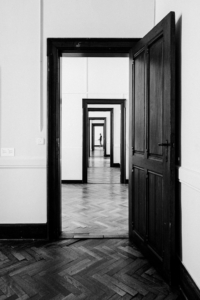
Image from a series called “The Doors of Perception” by Koen Jacobs.

This experience and others lead Huxley to believe that we perpetuate our ways of thinking through the preservation of language. He thinks that we, human beings, are the benefactors of communication and also the victims of being told how to decipher the world’s meanings. We regurgitate them over and over.

When I first read this book circa 2005, I loved his dramatic language, wit, and intellect. I was living in France at the time. It was the Bush Era and the “War on Terror.” When there was still glee over the internet’s possibilities: the freedom of information through an interconnected democratic sphere. I had a tiny pay-as-you-go, Nokia phone with only the information capacity of text messages. I carried a camera with film in it. My life and the internet were separate. If I wanted the internet I had to leave my home and search for it. Equally, when I was done, I left it behind.

Around then, I tried psychedelics on the French island of Corsica. It must have been the mix of youth, curiosity, and living in the country Albert Camus was from that turned my perception of the world into a diorama. I saw layers of life added and removed. There was a lack of hierarchy between humans, insects, air, and trees. Mostly, there was a sense of oneness, what the people who invented the internet perhaps wanted to create for the world. The same internet that is now overwhelming, addicting, and making me numb.

Although my psychedelic experience was dreamlike, life still seemed to coalesce with nature and time. Back then, I wasn’t up all night thinking about the levels of CO2 in the air as equivalent to how much more time I have left to live before the apocalypse. I still thought fascist governments were a dying regime. I thought about a better future that was enlightened with many different existences, points of view, perceptions and solutions to the problems I knew existed and needed to be faced, including the environmental, social and economic inequalities of the earth. I had the Obama-era hope that society, equity and policy would improve. I thought there was time.

The clarity Huxley described is that humans have established systemic reasoning in order to make the chaotic world more understandable. However, the languages and semantics humans have created leave out a lot of (nonverbal) communication and comprehension. Life and existential reality have changed immensely in the past two decades. Many of us exist in the world today on a level of virtual reality that can be a phantasmagoric experience on its own, so perhaps the system of reasoning needs to be reevaluated? My main concern is: can our programmed brains think enough out of the box to find resolution to social and environmental catastrophe?

My favorite moment in The Doors of Perception was, during one of the mescaline observation experiments, when Huxley reported he felt particularly outside of “…the world of selves, of time, of moral judgements and utilitarian considerations, […] of self-assertion, of cocksureness, of overvalued words and idolatrously worshiped notions.” […] he began to laugh saying: “What pretensions! Who on earth does he think he is?” […] to humans in general: “Who did they all think they were?”

This is what I feel daily when faced with the onslaught of information showing the destruction and exploitation of the natural world by humans, social inequality, and the political circus. The preposterousness renders a sort of hysteria and then a shut-down; a burn out. Who do we all think we are? Capitalism has instilled a priority of the individual, when the survival of life on earth is dependent on unified, community-based thoughts and actions; a sense of oneness.

There seem to be too many doors open at once: screens, websites, photos on Instagram (and all of the emotions behind seeing and comparing oneself to others), yet I feel increasingly alone. I’m losing hope. Someone once said to me: “we are unable to comprehend the truth of the world all at once.” The doors of information offer too much information for the human mind to grasp, particularly if you care about (or are on the underprivileged side of) social, environmental and economic justice. And with the climate crisis, even just to believe there is a future ahead of us is a challenge.

Now, I see Huxley’s words differently. Their meanings are more profound. We must look beyond human history and habit and alter our perceptions to systemic reasoning because there is no premise for what comes next. If we can alter our perceptions, we can allow ourselves to focus our attention on a single goal and complete it. If we can concentrate on oneness, we may evolve to create something new.

Huxley finishes the book with something that society today can learn from: “[…] the man who comes back through the Door in the Wall will never be quite the same as the man who went out. He will be wiser but less cocksure, happier but less self-satisfied, humbler in acknowledging his ignorance yet better equipped to understand the relationship of words to things, of systemic reasoning to the unfathomable Mystery which it tries, forever vainly, to comprehend.”
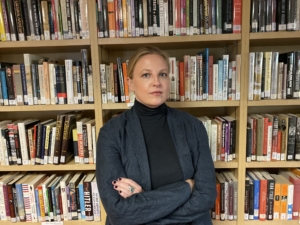
Franz is an urban sustainability practitioner and MFA student at Antioch University. With an international background and previous masters’ in urban design, she concentrates her writing on how cities impact the psyches of citizens. She lives in Los Angeles.

Friday Lunch Archive

  • 2025
  • 2024
  • 2023
  • 2022
  • 2021
  • 2020
  • 2019
  • 2018
  • 2017
  • 2016
  • 2015
  • 2014

Midnight Snack

Take a bite out of these late night obsessions.

Tonight’s bites:

The Lilac and The Housefly: A Tale of Tortured Romanticism

October 24, 2025/in Midnight Snack / Nikki Mae Howard
Read more
https://lunchticket.org/wp-content/uploads/2025/10/Headshot_Nikki-Howard_1770x2000.jpg 2000 1770 Nikki Mae Howard https://lunchticket.org/wp-content/uploads/2021/12/lunch-ticket-logo-white-text-only.png Nikki Mae Howard2025-10-24 23:55:032025-10-20 10:59:03The Lilac and The Housefly: A Tale of Tortured Romanticism

Dig Into Genre

May 23, 2025/in Midnight Snack / Lauren Howard
Read more
https://lunchticket.org/wp-content/uploads/2025/05/Lauren-Howard-credit-Terril-Neely-scaled-773x1030-1.jpg 1030 773 Lauren Howard https://lunchticket.org/wp-content/uploads/2021/12/lunch-ticket-logo-white-text-only.png Lauren Howard2025-05-23 23:59:492025-06-17 18:29:02Dig Into Genre

The dreams in which I’m (not) dying

April 25, 2025/in Midnight Snack / paparouna
Read more
https://lunchticket.org/wp-content/uploads/2025/04/paparouna-photo.jpeg 960 720 paparouna https://lunchticket.org/wp-content/uploads/2021/12/lunch-ticket-logo-white-text-only.png paparouna2025-04-25 23:55:312025-08-14 16:18:41The dreams in which I’m (not) dying

More Midnight Snacks »

Amuse-Bouche

Little bites every third Friday to whet your appetite!

Today’s plate:

Till Death

May 15, 2026/in Amuse-Bouche, Translation / Lorea Canales, translated by Lia Galván
Read more
https://lunchticket.org/wp-content/uploads/2026/04/galvan_headshot_translator-scaled.jpg 2560 1887 Lorea Canales, translated by Lia Galván https://lunchticket.org/wp-content/uploads/2021/12/lunch-ticket-logo-white-text-only.png Lorea Canales, translated by Lia Galván2026-05-15 12:01:552026-04-30 16:34:25Till Death

Making Friends

May 8, 2026/in Amuse-Bouche, Flash Prose / Robert L. Penick
Read more
https://lunchticket.org/wp-content/uploads/2026/04/Bob-Headshot.jpeg 1600 1065 Robert L. Penick https://lunchticket.org/wp-content/uploads/2021/12/lunch-ticket-logo-white-text-only.png Robert L. Penick2026-05-08 12:01:262026-04-30 15:56:02Making Friends

Two Poems

May 1, 2026/in Amuse-Bouche, Poetry / Jessie Raymundo
Read more
https://lunchticket.org/wp-content/uploads/2026/04/Jessie-Raymundo-Headshot.jpeg 2374 2265 Jessie Raymundo https://lunchticket.org/wp-content/uploads/2021/12/lunch-ticket-logo-white-text-only.png Jessie Raymundo2026-05-01 12:01:432026-04-30 15:36:29Two Poems

More Amuse-Bouche »

School Lunch

An occasional Wednesday series dishing up today’s best youth writers.

Today’s slice:

I’ve Stayed in the Front Yard

May 12, 2021/in School Lunch, School Lunch 2021 / Brendan Nurczyk
Read more
https://lunchticket.org/wp-content/uploads/2021/05/SL-Insta-Brendan-Nurczyk-2.png 1500 1500 Brendan Nurczyk https://lunchticket.org/wp-content/uploads/2021/12/lunch-ticket-logo-white-text-only.png Brendan Nurczyk2021-05-12 10:18:392022-02-01 13:24:05I’ve Stayed in the Front Yard

A Communal Announcement

April 28, 2021/in School Lunch, School Lunch 2021 / Isabella Dail
Read more
https://lunchticket.org/wp-content/uploads/2021/04/SL-FB-Isabella-Dail.png 788 940 Isabella Dail https://lunchticket.org/wp-content/uploads/2021/12/lunch-ticket-logo-white-text-only.png Isabella Dail2021-04-28 11:34:132021-04-28 11:34:13A Communal Announcement

Seventeen

April 14, 2021/in School Lunch, School Lunch 2021 / Abigail E. Calimaran
Read more
https://lunchticket.org/wp-content/uploads/2021/04/SL-Insta-Abigail-E.-Calimaran.png 1080 1080 Abigail E. Calimaran https://lunchticket.org/wp-content/uploads/2021/12/lunch-ticket-logo-white-text-only.png Abigail E. Calimaran2021-04-14 11:22:062021-04-14 11:22:06Seventeen

More School Lunch »

Word From the Editor

Editing issue 28, I felt something similar to the way I feel near water: I dove into my own private world. The world above the surface kept roaring, of course. The notifications, deadlines, the constant noise was always there. But inside the work, inside these poems and stories and artwork, there was a quiet that felt entirely mine. A place where I could breathe differently.

More from the current editor »
Current Issue »

Connect With Us

lunchticket on facebooklunchticket on instaX
Submit to Lunch Ticket

A literary and art journal
from the MFA community at
Antioch University Los Angeles.

Get Your Ticket

We’ll keep you fed with great new writing, insightful interviews, and thought-provoking art, and promise with all our hearts never to share your info with anyone else.

Newsletter Signup
Copyright © 2012-2025 LunchTicket.org. All Rights Reserved. Web design and development by GoodWebWorks.
Scroll to top Scroll to top Scroll to top