
Connecting the Dots of Silence: An Interview with Roberto Lovato
Roberto Lovato’s book Unforgetting: A Memoir of Family, Migration, Gangs, and Revolution in the Americas was published by Harper in 2020. In this memoir, Lovato, who was born and raised in San Francisco by Salvadoran immigrant parents, portrays his coming-of-age journey from San Francisco Giants fan who pledged allegiance to the U.S. flag, to evangelical Christian, to UC Berkeley student, to Salvadoran guerrilla revolutionary, to investigative journalist.
 An alumnus of Antioch’s MFA program in creative writing, Lovato is an educator, journalist, and writer based at the Writers’ Grotto in San Francisco. A recipient of a reporting grant from the Pulitzer Center, Lovato’s writing has appeared in such venues as Guernica magazine, The Boston Globe, Foreign Policy magazine, The Nation, The Guardian, The Los Angeles Times, Der Spiegel, and La Opinion. As an educator, Lovato was, until 2015, a fellow at UC Berkeley’s Latinx Research Center. In 2021, he taught at UCLA and was a special guest at the Antioch MFA program’s December 2021 residency.
I spoke with Lovato online in November 2021 about his education in the Americas, his mission as a writer, and his 2020 memoir, Unforgetting.
Kevin Cummins: Could you talk about the title of your book – Unforgetting?
Roberto Lovato: I had several original titles, one of which was Digging for Salvation. Another one was Américan with an accent on the E because I stopped calling myself American long ago. As you read my book, you’ll discover I saw some horrific things done with the support of America: killing babies and destroying mothers. I’m not even talking about migration and the desert. I’m talking about bombs, and strafing that I saw, and the victims I saw in the families that I interviewed. I tried to find a title that spoke to the issue of memory, that spoke to the pursuit of truth, that it’s being hidden from us. I wanted a title that was catchy. I got the concept of unforgetting when I was a right-wing, born-again Christian. You know, somebody who got on his knees and voted for the proto-fascist Ronald Reagan. I got into being a Christian because it saved me from a life that was dangerous. As a youth, I was involved in violence and stealing, what some would call gang activity. I saw it as just being a kid when I was growing up. Because one thing is the image of the gang, and the other is the actuality. I started taking hard to the Bible and to Christianity, and I dreamed of being like one of my heroes, Jimmy Swaggart, the right-wing preacher. I went to Bible school, studied theology, and I heard about this concept: aletheia. It comes from the Greeks. In between the lines, there’s a lot of Greek philosophy inside of what we call the Bible. Aletheia refers to the journey that the Greeks believed the dead would have to take upon dying. To get to either Elysium or Hades, the dead would have to cross the Lethe River, the River of Forgetting. To move forward, the dead had to forget who they were in life.
After I left the church, I went to Berkeley as a transfer student from community college because my high-school grades sucked. I studied rhetoric and philosophy and I took a German philosophy class, where my professor introduced the work of Hannah Arendt, and Arendt had this concept of aletheia that she borrowed from her former colleague and former lover, Martin Heidegger. Arendt applied the Greek idea of unforgetting to the necessary work of struggling in the theater of memory against fascism. Because fascism has deep-rooted amnesia tied to the nation state. Unforgetting is a way to fight fascism. During the war in El Salvador, I heard about memoria histórica – historical memory, which is the use of memory as an instrument in the struggle for justice. I thought, Wow. For just my own personal story of unforgetting: things I was taught to forget in my family, things I was taught to forget as a person of the United States, things I was taught to forget about El Salvador, and things I was taught to forget about myself. Some of the best parts of myself, I had to keep secret.
And there was a whole mass graves element to what I do in the book, there’s a whole war thing. There’s the underworld of gangs, the underworld of the guerrillas, the underworld of death squads, and the states. These all involve elements of forgetting. For all these reasons, I thought it was just perfect to name it Unforgetting.
KC: Could you talk about the Náhuat story of the underworld that appears as a short chapter in the middle of your book? You slip it in without saying much about it.
RL: The Náhuat origin story involves the underworld. I knew from studying myths and religions that you get the underworld story at moments of crisis when the world above the underworld, la superficie: the surface, is inadequate to the needs of the people. In our case, for example, we’re not getting the real story about what Biden, Trump, Obama, or the United States are doing to Central American children and mothers. We’re being taught it was the evil Trump, but there’s a history there that makes us all complicit. I wanted to get at that history, so I went to the underworld. I’m a creature of the underworld because I was in all these underworlds. I have friends who are Pipil Nahuats, one of the indigenous groups of that region, and I was familiar with some of the origin stories. I wanted to say to the reader, Hey, there’s all these different kinds of underworld in this story. There are different ways to look at death, different ways to look at history, and different ways to look at ourselves, outside of a nation-state identity. My story involves a lot of telling a story of what happened to the indigenous people of El Salvador. That’s why I put it in.
KC: Could you talk about how you found a structure for Unforgetting? Whatever material you wrote early on, my hunch is you didn’t yet have the structure for the book. Did you have an epiphany where you recognized how you would layer your stories, your father’s stories, and the cultural stories of the Americas?
RL: I didn’t set out to write a memoir when I started. I wanted to get at the roots of violence as a journalist. And then I realized, I have some experience in these matters that maybe I could share with people to help them understand the heart of a Salvadoran like me, a Salvadoran born in the U.S., here in San Francisco. I wanted to bring in my dad because my dad has an astonishing story. I don’t want to give it away because I want people to read the book.
KC: Your father’s story is fascinating, and the book is well worth reading. You layer your family story and the silences in the family with the cultural silences in both El Salvador and the United States.
RL: Right. How do I connect the dots of silence? Of the silences that I’ve excavated in this underworld journey? When I discovered my dad’s story, my head blew up. It explains a lot about me, explains a lot about my family, explains a lot about El Salvador, and it even explains some about the U.S. So how do I bring the reader to the A-ha! moment that I had, when my dad breaks the silence that he held for almost 70 years? I kept playing with the structure. I owe Antioch a debt of gratitude. While I was taking a class with Brad Kessler, who was my mentor, he told us about this braided narrative where there’s two layers: a layer above is the present, and another layer below is the past. A braided narrative weaves the present and the past. I experimented with a triple-braided narrative when I wrote an essay for Guernica magazine called “Rich Eyes and Poor Hands,” after a quote from Shakespeare. It took me a long time, but I think it worked because the article got a lot of plaudits. Okay, I thought: what I did with the essay, I will do with the book: I’ll braid the narratives of three different strands. First, my present-day search, as a journalist, to understand the roots of violence and what turns a child into a killer. Second, my own story—the conflict that led me to become a rebel, in my family and as a revolutionary. And the third strand is this heavy story about the child my dad kept in silence, a silence he broke with me in 2000. Each section of the book braids these three strands. It’s one of the most difficult things I’ll probably ever do as a writer. I may never write another braided narrative, again. It’s so hard, but I think it was worth it. These three layers, constantly shifting, help readers to connect to history. Every thing has a history. Every one has a history. I wanted to show how things like terror have a whole history. What you’re seeing on the screens when you see children caged and separated: there’s a whole history underneath what those families are fleeing, a history I have been witness to in the last 30 years—as a reporter and as a former revolutionary—and my father has witnessed for almost 100 years.
When it came time to turn in the first draft of my manuscript to my editor at HarperCollins, Erin Wicks, I looked up how many words your average memoir has, and it’s like eighty to ninety thousand. I had written 145,000 words. So, a week before I was going to turn it in, I had to edit it down. In the process, I realized, wow, the way to do this braided narrative, is to keep the chapters short. Make it easy for anyone to just step into a story, leave it, and then come back two chapters later, to that same story. To connect the dots.
The act of writing … is stitching together the bones of our memory to tell a story.
Memoir takes fragments of memory and weaves them together into a cohesive to tell a larger story. It’s also the way I see the act of writing, which is stitching together the bones of our memory to tell a story. It’s different from biography or autobiography which is telling your life story, birth-to-death. A memoir only tells a piece of story made up of other pieces to make a larger point. I also thought it was an efficient way to communicate my distaste for what nation states do to human beings, which is distort our identities, separate us as peoples, and perpetrate violence that fragments our memories. A braided narrative is also an elegant way to communicate the fragmentation of modernity.
KC: You mentioned your gratitude to Antioch and how your MFA mentor Brad Kessler steered you toward a braided narrative. Do you value any guidance given to you by peers—fellow students—in the Antioch MFA program?
RL: At Antioch, I had written several chapters and was piecing the book together when I wrote a scene with these urban commandos meeting to plan attacks against the Salvadoran military. I wrote it in the omniscient third, and shared it in an MFA class, where everyone reads each other’s material and critiques it. My classmate, Mireya, says, “This is a great story, but how does the author know about these activities? Is this fiction, or is it a true story?” She put her finger on it, so I said, “I was that guy.” Then I had to ask myself: How do I introduce this secret part of my life that I never revealed to anybody outside of intimate friends and family? To reveal I was a former guerrillero was very unsafe for me to say because I have experiences with the FBI and the CIA trying to infiltrate groups that I belong to. Through the Freedom of Information Act, documents that my lawyers got show that they were considering us a terrorist organization. So, I have all this paranoia about the U.S. government and other institutions looking unfavorably at my former guerrilla work, even though it’s the best part of me that was willing to sacrifice his life for a higher ideal. But after I went through that critique with Antioch, in that class, I thought, “Okay, I’m going to go for it: I’m going to come out.” So, I wrote the book as a former guerrillero, and it gave me a certain freedom to share something I held under my vest for almost 25 years.
KC: “I never let my schooling get in the way of my education,” Mark Twain wrote. How did you learn to see history the way you portray it in your book? Were your schooling and your education ever in conflict? You write about attending Mission High School in San Francisco. Is there a moment from your time there that portrays your experience of learning how history works?
RL: I’m entirely public educated, but I had some good teachers, and I really connected with my English teachers from an early age. I grew up in a working class, poor immigrant, crowded apartment. But I had these two magic powers, given to me by my mother, who was a maid, and my dad was a janitor. She was a maid at Hyatt Regency, and he was a janitor at United Airlines, so I got a discounted hotel and free airline tickets to travel around the world. I traveled around different parts of the world, but I was coming home to play around the projects.
I remember this Mission High School class, where the teacher was talking about Napoleon and how bad he was, and I was like: Actually, Napoleon was neither good nor bad; he simply was. This was a reactionary teacher who wore these Laura Ashley dresses with a very coiffed haircut in this predominantly working-class Latino school. I spoke up. I said, “Hey, Napoleon was a complicated figure. He did some of the things you’re talking about, but he also introduced the Napoleonic Code, and he raised France out of the defeat of its past, and if you go to France, people don’t feel the way you’re talking about him.”
KC: Your book introduced me to the poet Roque Dalton, an important poet in Salvadoran cultural history and in your book.
RL: And in the Americas. He was admired by Pablo Neruda, Eduardo Galeano, Julio Cortazar. Some of the greatest writers in the Americas and in the world admired Roque Dalton, who was also a guerrilla fighter. He was a guerrilla poet.
I discovered Roque Dalton thanks to my cousin. There’s a scene in the book where I’m in El Salvador, and my dad is involved in all these underworld activities in contraband. He goes out and sees other women and sex workers. I’m pissed off at my dad, so I expose some of his secrets. He beats me up and humiliates me, and I’m crying. My cousin, this really funny guy, saw me. He pulls me over. He says, “I want to show you something.” He cajoles me into getting out of my sorrow. He takes me under a tree in the back, digs up these plastic bags, and takes me to his room. In the plastic bags were revolutionary pamphlets, cassette tapes with revolutionary music, and poetry by Roque Dalton. My cousin shared it with me, and I didn’t understand it all, but I liked this phrase: Todos nacimos medio muertos: We were all born half dead.
So, then, after being a right-wing Christian and transferring from junior college, I went to Berkeley, where I had this teacher named Leonard Nathan, an eminent, formalist poet who taught the idea that we should critique and analyze just the text, nothing external to the text is relevant to the text. Extreme formalism. Nathan had a booming voice, wore ascots to class, lived in the Berkeley hills, drank wine, was renowned in the poetic world, and was a friend of Czeslaw Milosz, the Nobel laureate. So yeah, he was a big wow. But, as a street kid, I brought an attitude: Any of these teachers piss me off, I’ll put a bullet in their kneecap. That was my attitude as a kid because of how I grew up. So, in this poetry class that Nathan’s teaching, I had one option to do an elective report that was not based on something that he assigned. I chose Roque Dalton, and I brought Nathan his poetry. “He’s just a Marxist pamphleteer,” he said. “He’s not a poet. That’s not poetry. I’m teaching you real poetry.” Nathan pressured me not to write about Roque Dalton, but I pressured him back by going to the chair of the department and saying, “Hey, advisor, is it okay if I do this? He’s telling me I can’t write about Roque Dalton in his elective.” I got my way.
Cut to another part of the campus, where I’m studying with June Jordan, an eminent poet in her own right, but of a more emancipatory inclination. She was about freedom in her bones. She used what I would call educación popular techniques based on the pedagogy that Paulo Freire spread like wildfire throughout the Americas. There’s an element of framing and pedagogy in the Salvadoran revolution, the Guatemalan revolution, the Nicaraguan Revolution, and revolution throughout the Americas, because educación popular teaches students how to read, but in between the lines of reading is the work of liberation. It’s a gorgeous, powerful pedagogy. June Jordan used the same techniques. She said, “Okay, you learn how to write poetry, you know how to analyze poetry. Now, take your learning into the Mission District or into Oakland to teach workers how to write and analyze poetry.”
It’s like night and day. With Leonard Nathan, you have this formalist who doesn’t want to look at the world outside the text. With June Jordan, she looks at the world and pushes you to have your poetry connect to that world. From June Jordan and the guerrilla poet Roque Dalton, I drew my inspiration for what I wanted to do in life.
KC: What book or books have guided you in writing this memoir?
RL: Obviously, Roque Dalton. His Poemas clandestinos – Clandestine Poems – describe the journey of many Salvadorans, in my case, the journey from being a boy who was half dead to being a man who is fully alive. There’s a whole subtext about masculinity and toxic masculinity that I’m trying to deconstruct in the book.
June Jordan, as much as anyone. Adrienne Rich. Audre Lorde: another poet. There’s a journey of health in my book. It has some heavy stuff, but there’s a lot of levity. I’m very California: I’m into health. When I talk at student events, as a former guerrilla fighter, I say, “How many of you want to be dangerous in this world?” A lot of hands will go up. “So, in a diseased society,” I say, “do you know what’s the most dangerous thing you can do? Be healthy.”
In a diseased society, do you know what’s the most dangerous thing you can do?
Be healthy.
But perhaps the most powerful literary influence on me for this book was Italo Calvino, one of the great writers of the 20th century. When he was about to die of cancer, he wrote this series of essays about six qualities that make for great writing: Six Memos for the Next Millennium. In the essay called Lightness, he says the job of the writer is to bring levity to the heavy marble, the concrete, the thick, deep crises of the world. As a veteran of war, Calvino carried a lot of pain. He thought his role as a writer was to lighten the load. The gravity is not going to go away, not at a time of climate change, right? We’ve got gravity for the foreseeable future. The job of the writer is to bring some levity. Not just humor, but to lighten up the story in magical ways that make it easier to look at the abyss, to look at the difficult things the world has to offer.
We need to lighten the weight of the world we live in.
A great metaphor Calvino uses, even if it’s sexist, is Perseus slaying Medusa. When you look at Medusa, it turns you to stone. Perseus needs to slay Medusa but can’t look directly at it. So, he looks at Medusa through a mirror, to be able to do what he needs to do. We need to lighten the weight of the world we live in. Calvino’s writing about levity moved my heart. If I had to edit my book, I would say, “Thank you, Italo Calvino.” I’ll have to thank him in the next edition.
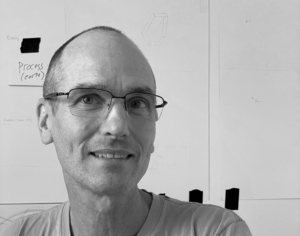
Kevin Cummins, an MFA candidate at Antioch University Los Angeles, was born in Queens, raised in western New York, and has taught in Brooklyn, San Francisco, and on St. Croix in the Caribbean Sea. He holds an MA from the Bread Loaf School of English and lives in Albuquerque with his wife, two children, cat, dog, and drop-in roadrunners. He’s on Twitter @kevinjcummins and Instagram @kjc6degrees.