My Infinite Library
 The first book I remember enjoying was Nose Is Not Toes by Glenn Doman. I didn’t know it at the time, but it was designed not just to teach you how to read, but as an aid in developing cognitive and intellectual ability. Mostly, I liked it because it was entertaining and had fun pictures. I don’t know if that book succeeded in its underlying intention, but I have found that reading often surprises me with new and unexpected insight into myself and the world around me.
Reading became an important part of my life, though I didn’t start developing my own library until I was about twelve-years-old. I grew up mostly in Montclair, New Jersey, which is about sixteen miles due west of Yankee Stadium. During early grade school, I remember books like Green Eggs and Ham by Dr. Seuss, of course, followed by The Giving Tree by Shel Silverstein. But I quickly moved onto things like some of the Hardy Boys books, and when I was ten-ish, I started getting into the likes of Edgar Rice Burroughs and The Chessmen of Mars.
When I was thirteen, we moved to Middletown, New Jersey at the north end of the New Jersey shore. We all hated it there. The intention had been a bigger house with a bigger yard. But Montclair and its schools were strongly progressive, and Middletown was not. The culture shock was too much for all of us, and we moved back to Montclair after about a year and a half. For me, the lack of friends in Middletown was just one of the incentives I needed to start building my own library.
I read for a lot of reasons, the main one being that I like to. My own interest, passion, and obsession drives most of what I read. But there are other things that prompt additions to my ever changing library. One of those, admittedly, is ego. I’ll read books I think will impress people, but also books that other people think are “important” or otherwise “cool.” God forbid I come off as un-cool. Without a disciplined and rigorous spiritual practice, I am a slave to my craving for approval. Then, there are assigned school readings, which have included a wide range of books on politics, history, business, and works of fiction. There is also technical reading I have done on my own, mostly related to whatever business I was involved with at the time.
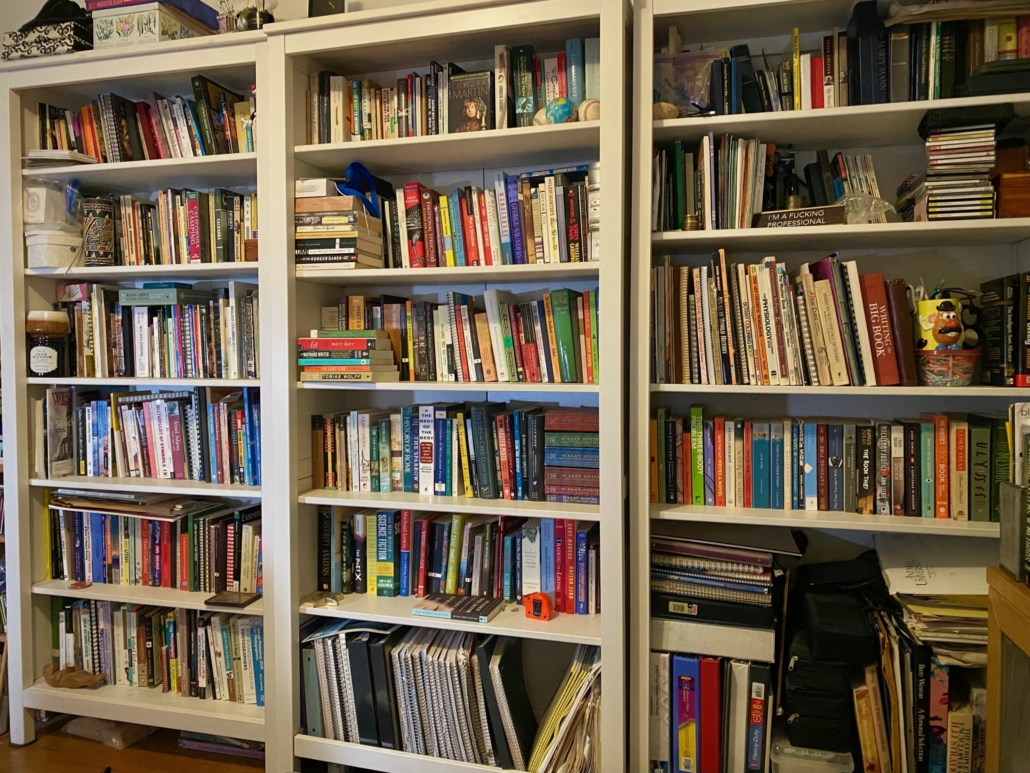
As mentioned above, I have been on a spiritual journey that has also guided my reading. Having spent most of my adult life in recovery, my library displays certain books that have helped me along the way, with some enduring multiple readings and close studies throughout the years. I grew up in an alcoholic home, and at different times, experienced physical and emotional violence from various family members. In the case of my parents, I knew they loved me, but I couldn’t trust them because of their alcoholism. I could see they were trying. That was obvious. But the issue of trust was buried so deep that it had a profound effect on my relationship with God and the world around me. I didn’t fully trust anybody, including myself. People around me, at school and in the world, said they cared about peace but supported war, said they believed in a loving God but hated people that didn’t look like them, said one thing and did another. My library became a safe and wondrous vessel that opened windows into alternate realities and ways of living, as well as deeper truths about the universe. I was looking for a moral center in a world that didn’t seem to have one. It took time, but I did finally find a moral purpose in recovery, something I am deeply grateful for. My library has been a trusted companion on that journey. Love is love eternal, and it’s passed on one to one.
The first genres in my library were science fiction and history. Back in the late 1960’s, Ballantine Books had this great series on World War II, and I remember devouring books loaded with pictures and salacious details about different aspects of the war. I had at least twenty of those books. By the time I was twelve, my experience with the world had bred in me a desire to understand the roots of violence and how to stop it. My interest in World War II led me directly to readings on the Holocaust. I went through several books that gave me a good understanding of what happened but didn’t really offer a pathway to change. Those readings in turn led me into looking at the violence closer to home: slavery and its continuing forms in America. I read books like The Autobiography of Malcolm X by Malcolm X in collaboration with Alex Haley, Native Son by Richard Wright, and Manchild in the Promised Land by Claude Brown.
My first library was also packed with science fiction. I was first turned on to the genre in the mid-1960’s by television shows like Lost in Space, Time Tunnel, and Star Trek. Those imaginary worlds, particularly Star Trek, made a lot more sense to me than the insanity I saw around me. My awareness of the larger world had been initiated by the Cuban Missile Crisis in 1962. I understood the threat of nuclear war at a basic level. We had drills at school (like that was going to help). But what I really got was how completely freaked out everybody around me was. That awareness never left me, in no small part, because the threat of annihilation remains. It’s always just an hour away. Science fiction is an exercise in “what if.” If we make these choices today, they might manifest like this. Some sci fi was very wild and dramatic, but some of it, particularly and purposefully, Star Trek, was very hopeful. That got me into reading the popular sci fi writers of the time like Isaac Asimov, Robert Heinlein, Arthur C. Clarke, and Ray Bradbury, among others. I remember taking great pride in reading the entire Foundation trilogy by Asimov. I think that was the first really big work I had ever read. And that gave me the desire to read other “big” books like The Rise and Fall of the Third Reich by William L. Shirer, War and Peace by Leo Tolstoy, and some of the James Michener books like The Source and Centennial.
My high school years saw an expansion of my library into more literary work. I continued with science fiction and history as a kind of baseline and was assigned reading of literary works that I initially resisted but later came to enjoy. David Copperfield, by Charles Dickens, was a book I hated at first. But as I slogged through, I came to enjoy the intimate experience with the characters. That led me to books like Slaughterhouse-Five and Cat’s Cradle by Kurt Vonnegut, Narcissus and Goldmund and Steppenwolf by Hermann Hesse, and Crime and Punishment and The Brothers Karamazov by Fyodor Dostoevsky, which were both books I was proud to have read.
As I mentioned, ego has been one of the catalysts for some of my reading. Being able to say I’ve read such and so is still something I hang onto. While I continue to battle that kind of pettiness, the ego-driven aspect of my reading has gotten me to read some great books. In that context, I have to admit there are books I haven’t been able to finish for one reason or another. Ulysses by James Joyce is still on my shelf. I’ve tried three times and have only made it about halfway through. I’ve finally gotten to a place where I don’t feel obligated to finish or even start everything that comes across my path, regardless of the “cool” factor.
In college, I developed a particular affinity for women writers that has continued throughout my life. I’m drawn to emotional intimacy and authenticity. From high school onward, I also sought out non-American writers. My quest has been dedicated to finding unifying truths about humans, which requires casting a wide net in the great stream of words. Over the years, that has included books like To The Lighthouse and Orlando by Virginia Woolf, Fledgling by Octavia Butler, A Grain of Wheat by Ngugi Wa Thiong’o, One Hundred Years of Solitude by Gabriel Garcia Marquez, Nervous Conditions by Tsitsi Dangarembga, Drive Your Plow Over the Bones of the Dead and The Books of Jacob by Olga Tokarczuk, and Emma and Sense and Sensibility by Jane Austen. I love Jane Austen. She’s one of my all time favorites. In large part, because of writers like this, I have found that we humans share a lot of common ground, and that it is fear, and its stepchild resentment, that keeps us apart.
I was blessed with a lot of progressive teachers in both high school and college who were eager to crack open my mind and pour in many diverse influences. That included people like Cedric Robinson and Raghavan Iyer, who introduced me to readings like Capital and The Communist Manifesto by Karl Marx, and An Autobiography: The Story of My Experiments With Truth by Mohandas K. Gandhi. I became a firm believer in nonviolent change, that in fact, nonviolent change is the only kind of actual change possible. Through my readings I discovered that nonviolent action changes the playing field itself. All violence does is move pieces around the existing board.
My library has continued to be a fluid affair. A lot of books have come and gone. There are some, though, that have been on the shelf for a long time. My favorite book of all time is Siddartha by Hermann Hesse, the Hilda Rosner translation. I sometimes keep extra copies because I like to give it away. I have a few Bibles, though there is one that is special. When I first got into recovery in my mid-twenties, I was having some relationship issues. No surprise there. My spiritual guide at the time suggested that I give up girlfriends for a while and focus on my recovery, becoming friends with myself. Considering that is still a challenge for me at times, it was good advice. Anyway, after a fateful phone call with her in which I surrendered my will and my life to God, I stopped on my way home at a local bookstore and bought this Bible as a gesture of surrender. I wasn’t committing to any particular religion, just expressing a willingness. Driving home, I saw a friend I had become close with. She seemed ill and out of sorts, so I picked her up. She didn’t want to go home yet, so we went back to my place and ended up talking for a couple of hours, after which I did finally take her home. Three years later we got married. We’re still together. My surrender was genuine. Life happened along the way.
While I love reading in general, from books to articles to bathroom walls, fiction has been the foundation for my reading since I was a boy. Someone said recently, “Don’t fuck anybody that doesn’t read fiction.” There is wisdom in that. Reading in general, but fiction in particular, has been a gateway into the amazing diversity of the human experience. It allows me to experience healthy intimacy and authenticity on a daily basis. It was in recovery that I found the moral compass within, but reading has been a key feature of that spiritual journey.
Along with the rest, I have a couple of shelves dedicated to books on the craft of writing. Some, like Writing Down the Bones by Natalie Goldberg, have been with me for a long time. Others that have been especially helpful include Bird by Bird: Some Instructions on Writing and Life by Anne Lamott, The 3 A.M. Epiphany: Uncommon Writing Exercises That Transform Your Fiction by Brian Kiteley, and Save The Cat! Writes a Novel by Jessica Brody.
I love my perfectly imperfect library. There are probably books out there that I “should” read. But the more I read, the more I am led to read what I want to read, which turns out to be the books I should be reading anyway. My ever-evolving library is, in one sense, a reflection of who I am. But it has been more than that. The diversity itself, the depth of feeling, and the varied insight into life have helped to allow me one of the greatest gifts of all, the gift of becoming myself.
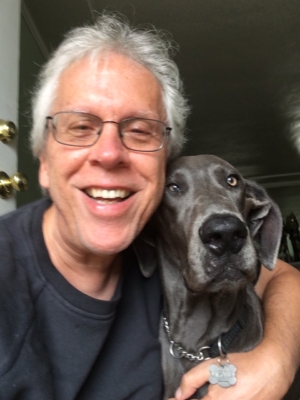
Robert Kirwin is a writer and multi-dimensional human with an MFA in Creative Writing from Antioch University, Los Angeles. He is currently working on drafts for a novel, a memoir, and several short stories. He has been rejected by some of the most prestigious publications in the world and continues to submit work wherever and whenever he can. He lives in Los Angeles, CA, with his tolerant wife, their dog, and two cats who keep a watchful eye on everything.