
Plastic-free Falafel Balls
Műanyagmentes falafelgolyók
A kókusztejben sok a tartósítószer, a biomandulatejnek meg olyan az íze, mintha ázott papírt rágcsálna az ember. Blanka már tíz perce áll a polc előtt, utálja, amikor valami megakasztja, mint egy YouTube-hirdetés a kedvenc sírós száma közepén. Visszateszi a kókusztejet, és már emelné le a mandulatejet, amikor ismerős mozgásra lesz figyelmes. Nem mer odanézni, de szinte biztosra veszi, hogy Balázs az, Ági pasija. Ugyanaz a rózsaszín ing van rajta, mint amit pár órája látott Ági Insta-storyjában, meg egyébként is, Balázst elég könnyű beazonosítani: kis konty a feje búbján, nagy, négyszögletesre nyírt szakáll, és úgy mozog, mint egy ufó, szinte lebeg, mintha a lába sem érné a talajt.
A szalmakalapját a kosárra dobja, hogy eltakarja a tartalmát, és arcát a telefonjába temetve a hűtőpulthoz oson. Reméli, ott biztonságban lesz. Balázzsal csak helyi termelőktől veszünk ennivalót, te mit tettél ma a környezetért, kérdezte Ági fitymálón előző posztjában. Blanka a falafelgolyókat figyeli, muszáj valahogy eltölteni az időt, megvárni, amíg Balázs elhagyja a boltot. Nem találkozhatnak, mert akkor Blanka lelepleződik. Mégse kellett volna kitennie a profilképére azt a „műanyagmentes július” pecsétet, de hát úgy érezte, nincs más választása. Mintha az egész internet azt figyelte volna árgus szemekkel, hogy ő mikor keretezi be az arcát a legújabb hype-pal. Mások is kirakták csak úgy, senki nem gondolta komolyan, hogy. Akkor ő miért ne blöffölhetne. Vagyis eredetileg nem blöffnek szánta, egy napig elhitte, hogy képes rá, és azt az elsejei bevásárlást tényleg nagyon meg is nyomta: vitt magával dobozokat, üvegeket, vászontáskákat, úgy felkészült, mint egy bevetésre, rohadtul el is fáradt, főleg, hogy mindent egyedül kellett hazacipelnie. De aztán másodikán és harmadikán rengeteg volt a meló, mára meg kiürült a hűtő, és csak bent jött rá, hogy muszáj vásárolnia, különben nincs mit ennie, és ha úgysem ússza meg nejlonzacsi nélkül, akkor most már csak azért is.
Belefeledkezik a műanyag dobozba zárt falafelgolyók látványába. Mindig büszke magára, amikor felvágott helyett falafelgolyót vesz. De ez a hülye műanyagmentes július most ezt is elvette tőle, még a falafelgolyót sem tudja jóízűen megenni, bár mondjuk amúgy se, olyan fűrészporíze van. Pótlék. Öt pici golyó egy dobozban, milyen kis aprók, milyen kis jelentéktelenek. Ági és Balázs is ilyen kis nyamvadt, jelentéktelen golyók, elzárva a világtól. Egy pillanatra megörül a gondolatnak, de hamar kijózanodik, mert megint megpillantja azt a furcsa, rózsaszín lebegést. A hűtőpult felé közeledik. Hihetetlen, hogy már itt sem lehet biztonságban, ahol minden be van csomagolva. Gyorsan felkapja a kosarát, és a tusfürdőkhöz siet; a végén már fut, lever két akciós babkonzervet, de nem mer megfordulni. Meg amúgy is: borotvát is kell még vennie, a mostani feje már alig fog, és mégiscsak július van. Bedobja a rózsaszín műanyag dobozt a kosárba, persze férfi borotvát kellett volna választania, hogy tüntessen a pink tax ellen, de szerencsére annak a kihívásnak már vége. Közben azon gondolkodik, hogy Ági vajon borotválkozik-e. Lehet, hogy úgy néz ki odalent, mint Balázs nagy szakálla, sőt talán Balázs egész feje ott van a puncija helyén. Blanka szereti néha megszégyenítő helyzetekben elképzelni azokat, akik idegesítően jól élnek; kajánul vigyorog, de hamar rájön, hogy az a szakáll nemcsak a képzeletében jelent meg, hanem beférkőzött a látóterébe.
Az újságos pultnál majdnem fellöki a nénit, aki a kempingszékén ülve rejtvényt fejt. Sokszor látja itt, ceruzával ír az újságba, a végén az egészet kiradírozza, és a lapot visszateszi a polcra. Nézi a vigyorgó sztárokat, akik arról beszélnek, hogy kizárták a műanyagot az életükből – és ezt persze a hatalmas, műanyag szájukon keresztül mondják. Arra gondol, hogy mint ezek a sztárok, talán Balázsék is blöffölnek, talán ők is itt veszik az előrecsomagolt vacsit, és Balázs talán azért jött utána, hogy feloldozza; ne félj, Blanka, mi is emberek vagyunk, tedd csak be azt a három doboz falafelgolyót a kosaramba, majd én elhordozom bűneidet. De tényleg, miért jött utána az újságos pulthoz, ha egyszer tonnaszámra vágják ki a fákat a papírért, ráadásul ők kivonultak. Fél éve jelentették be Ágival egy élőzésen, hogy úgy döntöttek, nem mocskolják be magukat a közélettel, ők azzal teszik a legtöbbet a Föld nevű bolygóért, ha a saját kis mikrouniverzumukban képviselik a tiszta és fenntartható szemléletet. Habár Blanka irigyli őket, mégis inkább megvetést érez irántuk. Persze ilyenkor sose tudja, azért veti-e meg őket, mert így próbálja elnyomni a saját bűntudatát – nekem is ezt kéne tennem, de lusta vagyok, ezért inkább megvetem őket –, vagy azért, mert Ágiék tényleg hatalmas, narcisztikus barmok. Nekik ebből áll az életük, Y generációs luxusszorongásban szenvednek – annyi mindent kínál az élet, de egyik sem elég fontos és izgalmas, ezért inkább egyiket sem választják, csak úgy elvannak, és ezt a tudatos életet fényezgetik maguk körül, amíg Ági apja eltartja őket.
A nagy szakáll már olyan közel van, hogy Blanka semmit sem lát tőle, és valami hirtelen elönti az agyát. Talán a sok műanyag, amit addigi életében megevett, eldugított egy fontos agyi eret – napi egy bankkártyányi, ezzel frusztrálta Ági a múltkori videójában, és a végén még teátrálisan fel is vagdosta az összes kártyáját, amivel addig a kizsákmányoló kapitalizmust építette. Blanka fogja az összes műanyagot a kosarában, és elkezdi hozzávagdosni a férfihoz, mit gondolsz, jobb vagy nálam, sikítja. A néni a kempingszékből odasandít, de aztán megnyugszik, hogy most nem őt szidják. Hogy te ettől hős leszel, de tudod, mit, falafelgolyók vannak a lábad között, fűrészporízű herék, és Blanka feltépi az egyik doboz falafelgolyót, kettőt a jobb tenyerébe markol, odanyomja a férfi ágyékához, és megtökörészi, egy tucatember vagy tucatszakállal, amikor ehhez a szóhoz ér, érzi, hogy valaki megszorítja a csuklóját, a biztonsági őr az, aki a fiatalember szíves elnézését kéri. Az ismeretlen férfi ijedten nyújtja át Blankának a szalmakalapját, amit útközben elhagyott, a biztonsági őr pedig kivezeti a boltból. Blanka csak áll a biztonsági kapuk mellett, és nézi a kosarát, ami a hajigálás során kiürült. Egy gramm műanyag sincs benne.
Plastic-free Falafel Balls
There are tons of preservatives in coconut milk, and organic almond milk tastes like soggy paper. Blanka has been standing in front of the shelf for ten minutes already, she hates when something holds her up, like a YouTube ad in the middle of her favorite heart-wrenching song. She puts the coconut milk back and is reaching for almond when a familiar movement catches her eye. She doesn’t dare look, but she’s almost certain it’s Balázs, Ági’s boyfriend. He’s wearing the same pink shirt she’d seen a few hours ago on Ági’s Insta-story, and besides, he’s easy enough to identify: his little man-bun, his big square-cut beard, and he moves like an alien, almost hovering, as if his feet don’t touch the earth.
She throws her sun hat on top of her basket to cover the contents, and burying her face in her phone rushes for the refrigerated section. She hopes she’ll be safe there. “Balázs and I only buy locally produced foods, what did you do for the environment today?” Ági’s latest snarky post asked. Blanka looks at the falafel balls, she has to pass the time somehow, to wait until Balázs leaves the store. They can’t meet, Blanka would be found out. She never should’ve added that “Plastic Free July” frame to her profile picture, but she didn’t feel she had a choice. It was like the whole internet was watching her every move to see if she’d framed her face with the latest hype. Others did it just because, no one seriously thought about it. So why couldn’t she fake it too? Although she didn’t originally intend to fake it, for one whole day she believed she could do it, and she gave that day-one shopping trip her all: she brought her own boxes, jars, canvas bags, it was like she was preparing for a deployment, and damn was it tiring, mainly because she had to lug everything home by herself. But on days two and three she’d worked late, and she’d only gone shopping today because the fridge was empty and she had nothing to eat, and if she couldn’t manage it without plastic bags, then so be it.
She’s transfixed by the sight of the plastic container of falafel balls. She’s always proud of herself when she buys falafel balls instead of lunch meat. But this stupid plastic-free July had taken that from her as well, she can’t even enjoy the falafel in good taste anymore, not that she does anyway, the flavor is like sawdust. In food form. Five little balls in a box, so tiny, so insignificant. Just like Ági and Balázs, lousy, insignificant little lumps, disconnected from the world. For a moment she’s happy at the thought, but quickly sobers up when she catches another glimpse of that strange, pink apparition. It makes its way to the refrigerated section. Unbelievable, even here where everything is packaged and sealed, she isn’t safe. She snatches up her shopping basket and rushes for the shower gel; she’s running by the time she gets there, knocks down some on-sale cans of beans but doesn’t dare turn back. And besides: she needs razors too, the ones at home are toast and it’s only July. She throws the pink plastic container into the basket, of course she should have gone for the men’s razors to protest against the pink tax, but luckily that challenge was already over. She thinks about whether or not Ági shaves. Maybe she has Balázs’s huge beard down there, maybe even his entire head there where her pussy should be. Blanka sometimes likes imagining people with annoyingly perfect lives in embarrassing situations. She grins wickedly, but quickly realizes the beard isn’t just there in her imagination, it’s bobbing into her field of vision.
She almost bowls into the old lady sitting in a camping chair and doing a crossword by the newspaper stand. She often sees her here, penciling in her answers, erasing everything when she’s done, and then putting the paper back on the shelf. Blanka looks at the smiling stars talking about how they’d eliminated plastic from their lives—which they of course tell us with their plumped up, plastic lips. She thinks that maybe Balázs and Ági, like these stars, are just faking it, maybe they also buy frozen dinners here, and the only reason Balázs was coming after her was to confess: don’t worry Blanka, we’re people too, go ahead and put those three boxes of falafel balls in my basket, I’ll bear your sins for you. But seriously, why was he following her to the newspaper stand? Millions of acres of trees are cut down for the paper, and besides, they’d signed off. Six months ago he and Ági had announced via livestream that they’ll no longer tarnish themselves with social media, they’ll do what’s best for this planet we call Earth by maintaining a clean, sustainable lifestyle in their own little micro universe. Even though she envies them, Blanka still hates them. Though she isn’t sure whether she despises them because she’s trying to suppress her own guilty conscience—I should also do that, but I’m too lazy, so it’s easier to hate them—or because they really are giant, narcissistic pricks. Suffering in their millennial, luxury-edition anxiety, that’s all life is for them—offering them so much, but nothing that’s important or exciting enough, so they never do anything with it, they just skate by, polishing this save-the-planet lifestyle around themselves while Ági’s father supports them.
The great beard is now so close that it’s all Blanka can see, and suddenly something within her snaps. Maybe some crucial vessel in her brain had gotten clogged from all the plastic she’s eaten in her life—a bank card’s worth every day, this was what upset her in one of Ági’s recent posts, and by the video’s end she’d dramatically cut up all her cards which had been contributing to the establishment of exploitative capitalism. Blanka takes every bit of plastic from her basket and starts ripping them open in front of the man, “What, you think you’re better than me,” she shrieks. The old woman in the camping chair starts, glances at her, but relaxes after seeing she isn’t the target of this abuse. “You may be the hero in all this, but you know what, there’s nothing but falafel balls between your legs, sawdust-flavored testicles,” and Blanka tears open one of the packages of falafel balls, grabs two of them, slams them into his groin, and pulverizes them, “You’re just a nobody with a nobody beard,” when she feels someone grabbing her wrist. It’s the security guard, apologizing profusely to the young man. The unknown man nervously hands Blanka the sun hat she’d dropped, while the security guard escorts her from the store. Blanka just stands there outside the security gate and looks at the basket she’d emptied during her onslaught. Not an ounce of plastic in it.
Translator’s Statement
The sparse nature of Mécs’s work might make a translation seem superficially easier, but in reality it adds a great deal of depth and challenge – just what a translator is looking for! Her short, clipped sentences are sometimes presented without much context, or are strung to together in one long, run-on sentence, where the scenes flicker by like pages in a flipbook. I often had to fight the urge to over-explain while translating Connection Error, and tried to leave the reader the space to interpret these cryptic sentences just as I had to. Both Mécs and I graduated from university with mathematics degrees before turning to writing and translating, respectively, so when I saw an interview in which she described her writing as “necessary and sufficient,” a common phrase used to describe the conditions for mathematical proof, the mathematician inside of me took hold of that and let it guide my translation as well.
Many stories from Connection Error highlight another interesting aspect of Mécs’s work, namely her ability to create fascinating ambiguities. It is often unclear in her stories whether or not something is truly happening, and if so, how or to whom it is actually happening. The penultimate sentence of “Plastic-free Falafel Balls” is a perfect example: who is the unknown man? Has she mistaken one bearded hipster for another, nullifying her panic as being based on a misunderstanding? Did she assume Balázs would recognize her just because she’d seen him on Instagram, but in reality he had no clue who she was? In “Drexit”, one of the most popular stories from this collection, a woman fabricates a fake life on Instagram to keep her family from knowing she’ll soon be dead from cancer – but in her delirious state, it’s unclear what she actually does and what she only thinks of doing. In the collection’s final story, “Swallowed by the Earth”, a woman trying to shed the technology dependence associated with her ex-fling from work battles with the Jason Voorhees of cell phones, indestructible and un-loseable. In “Selection”, a woman attending a therapy session while scootering around the city struggles to know whether or not she still exists – and after she crashes full-speed into an oncoming bus, she’s nowhere to be found. It is this necessary and sufficient, mathematical, mystical-yet-grounded style which drew me into Mécs’s work, and which makes translating it such a joy.

Anna Mécs was born in 1988. She graduated in Mathematics and Hungarian at Eötvös Loránd University, Budapest. After working in academic journalism, she now works as a creative writer. Her 2017 short story collection, Child Lock (Gyerekzár), won the Margo Prize for the year’s best debut Hungarian prose. Her second collection, Connection Error (Kapcsolati hiba), was published in 2020. As a mathematics graduate and former scientific journalist, metaphors taken from the mathematical mode of thought and scientific life often bring a new approach to her writing.
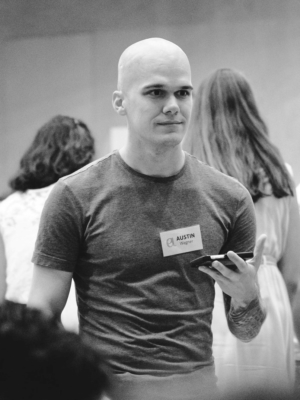
Austin Wagner earned his bachelor’s degree in mathematics from Augsburg University, with minors in physics and philosophy. After working as a data analyst in the United States, he moved to Hungary in 2017 to pursue his interest in the Hungarian language, and in 2020 won a scholarship to study literary translation at the Balassi Institute in Budapest. Since then, he has won several grants to translate a variety of Hungarian literature, from children’s and young adult books to contemporary literature. You can find many of his translations at Hungarian Literature Online, where he is also co-editor, and he has published and forthcoming work in The Continental Literary Magazine and Asymptote Journal. He is also active in alternative education, teaching mathematics and other STEM subjects in a variety of capacities.