Rick Moody, Author
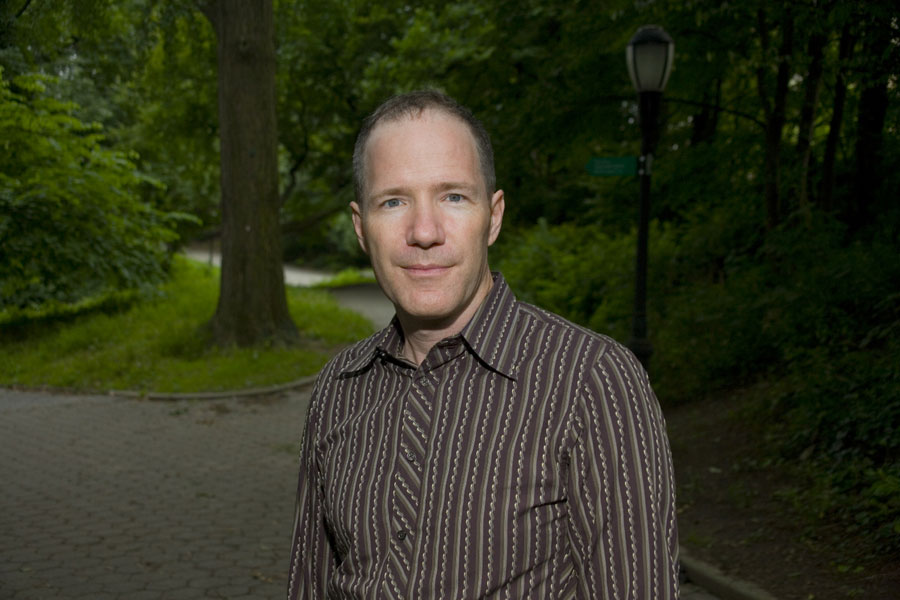
Rick Moody, photo Thatcher Keats
Rick Moody is a counterculture writer who once got to throw a pie in the face of his biggest critic. A New York City native, Rick Moody studied under Angela Carter and John Hawkes at Brown University and received his Master of Fine Arts degree from Columbia University in 1986. His first novel, Garden State, received the Pushcart Editor’s Choice Award in 1991. His latest work, On Celestial Music, is a collection of essays that delves deeply into music. The title essay was included in Best American Essays, 2008. In the time span between these two works, Moody has been prolific as a novelist, short story writer, and essayist while still finding the time to play in The Wingdale Community Singers band. He also co-founded the Young Lions Book Award at New York Public library, which recognizes young authors.
His memoir The Black Veil won the PEN/Martha Albrand award as well as the NAMI/Ken Book award. Moody’s novel The Ice Storm has been published in 20 countries, introducing more readers to his dark comedy and lyrical, evolving prose. His works, with their artful digressions and playful vocabulary, explore themes of addiction, family tensions, the inexorable pull of history, the limitations of language, and love’s failures. Perhaps the most impressive aspect of his career is his willingness to engage wholeheartedly in literary experimentation; having already enjoyed success, Moody does not grow stagnant; each of his works are distinct and speak to a writer not content to remain in familiar territory.
In his interview with Lunch Ticket, Rick Moody tells us about taking risks and his adaptive approach to storytelling. He also gives details about his forthcoming novel and talks about surviving and growing as a writer.
Robert Egan: How do you take risks as a writer? It’s as if, in addition to writing what you know, you’re writing to know. Would you elaborate on this exploration?
Rick Moody: I do, I guess, write to know, or to find out what I know. Or out of intellectual curiosity. It’s hard for me to imagine doing otherwise these days.
The reductive, conservative, story-heavy version of the novel, the English 19thcentury model, would seem hard for me to do now. I don’t believe in it. There’s no risk at all for me there. If I’m not discovering something in the process of writing, I get a little bored. So my recent tendencies are also somewhat about trying to avoid boredom. I don’t want to repeat myself. Even if that might mean a little bit more in the department of accessibility. I don’t know if that involves reinvention of self so much as a recognition that there is no one self there in the first place. That’s a loaded issue: self. I think we are probably more a society of tendencies than we are society of selves.
RE: Are there any rules or traditions that you won’t break? Or do you have a rule about breaking rules?
I haven’t met a rule yet that I didn’t want to break. Rules get their value from people breaking them.
RM: I haven’t met a rule yet that I didn’t want to break. Rules get their value from people breaking them. Without a certain amount of scofflaw activity, the rules wouldn’t exist in the first place. So go ahead: break them all. That’s how you learn which are valuable. However, here are two I like: stick to a minimum number of tenses, and avoid sentimentality.
RE: The notion that rules get their value from breaking them is intriguing, since we have to recognize these rules to be consciously subversive. There also seems to be a subtler subset of rules, camouflaged as habits. How do you uncover habits that you wish to break or redirect?
RM: I think what you say about habits is very interesting. At least in my case habits arise out of a tendency to want to avoid improvising new responses and solutions to the world on a daily basis: it would just take too long. Responding to the world as though new (I guess the Buddhists would refer to it as Beginner’s Mind) would just take too long. However, there is no art without Beginner’s Mind, without trying to create new pathways, new neural connections, each with its improvised narrative structure, all of them without or apart from routine. So: a habit is a logical and pragmatic way to approach life and literature, and probably essential in part, but also totally deadening. In a writing sense, I therefore try to root them out, these habits, and kill them. I want to be educable, no matter that I am rapidly becoming and old dog, a mid-career artist, a survivor. I want to be willing to grow despite this.
RE: How does your heightened sense of setting shape your stories. Also, for aspiring writers, do you have any suggestion on how they can let setting shape their work?
RM: I love landscapes, and they are important to me. The work shouldn’t only be about the people. It should be about their landscape as well. (And maybe ideas, too.) And to do so, to make use of landscape: just pay closer attention. Be a person, as I believe others have said, on whom nothing is lost. What does the city of Los Angeles feel like? I guarantee you it has real impact on the characters of the stories written there. Why not try to describe that fully? Car culture, and tanning salons, and breast implants, and hispanic people, and beaches, and mud slides, and water wars, and The Business.
RE: Your landscapes, from American Suburbia to Mars, are as diverse as your subject matter. What does traveling to new places do for people, their thought patterns and tendencies?
RM: I think travel broadens. There is a wealth of literature to support the idea. America is a straitjacket. When the opportunity arises, go elsewhere.
RE: If the place exists, is it essential to visit it or live there before writing about it?
RM: No, but it can help. I believe in imagination, so I believe some of the places to which we might travel are imaginary (see, e.g., Calvino’s Invisible Cities), but when they are not it sometimes helps to visit them.
RE: What’s next for Rick Moody?
RM: A new novel!
RE: Any hint as to what type of landscape we might encounter in this new novel?
RM: The new novel is in its infancy, but it concerns a radio producer who is badly injured in a roadside bombing in a certain Middle Eastern city, and who comes home to attempt to put the pieces back together. It is mostly realistic, though his memory is full of holes. It is, I hope, a bit dramatic. It is unfilmable. It is about the clashing of certain points of view. It has fewer jokes than the other books I have written recently.
RE: When you speak of trying to create new pathways and neural connections, the premise of your new novel sounds like it’s geared wonderfully to do just that. Does music play a role in trying to navigate a memory that is full of holes?
RM: I don’t know that music is going to play much of a role in the new novel. In fact, the character, Joshua Burns, has sort of bad taste in music. He’s from the Midwest, and has kind of a Farm-Aid sensibility with regard to music: John Cougar Mellencamp, and contemporary country, etc. But there is a music in radio, to radio, which is why he works there. The novel, in a way, is meant to be mostly aural. He doesn’t describe visual things, after a while just the way things sound. Or that is the idea. I don’t know if it will work or not. And a novel is what happens after you give up on all your original ideas.
RE: How has your long love affair with music shaped your writing career?
RM: Music gets me out of the house sometimes, into the world, and it also makes me a better listener, and that is good for my language, my craft. Music makes me think more carefully about language, about melody and rhythm. So it has shaped me a great deal, probably as much as literature has.
RE: How intentional is the use of brand names in your work? Are they used to subvert or evoke rather than directly advertise – is it branding used in an ironic sense?
RM: Right: the product placement is parodistic, spasmodic. And intentional. Literature is not supposed to have such things in it. But that rarified version of literature is something worth thumbing your nose at occasionally. If only because it makes you feel alive to do so. I bet there aren’t too many brand names in Thomas Mann. But I like them, and they feel as though they refer to a world I know well, and that is reason enough. Brands, though they are post-modern and dreadful are also, in the run-amok capitalism of now, totally realistic.
RE: During your visit to Antioch Los Angeles in December, you discussed imagination and revision and mentioned a scientific approach to writing. How do you view the relationship between this scientific approach to writing and the art of it?
RM: I don’t really think my approach is scientific so much as it is about boiling down the ineffable part of writing into some steps that may prove useful to anyone. I would use the word pragmatic. There are certain pragmatic steps you can take today to improve. I think that doesn’t de-romanticize craft entirely. There’s still a lot of room for creativity, as long as you agree to revise as well. So there are these two steps, the ineffable part (which involves imagination), and the pragmatic part, which involves rewriting. You should try to make use of each.
RE: Do you see your work as affecting any type of social change? What is your greatest hope for your readers? What’s your greatest hope as a writer?
RM: I believe in social change, and I believe that literature can serve that function, but I also think that social change, as an aesthetic agenda, can sometimes slow down the work, make it a bit sludgy, because social change, if you lean on it too much, can be a bit preachy in a novelistic context. For me, therefore, the goal is to find a way to get to that material without being heavy handed about it. One way to do that is: formal innovation. If you can change how people think, maybe you can change how they act.
To answer your other two enormous questions: a) I have no hope for my readers except that they are quixotic types who are willing to go to a new place with me, b) I am somewhat hopeless as a writer now, at least as regards my own fortunes. I guess I still want to save lives and change the world, but I would be satisfied with avoiding total obscurity.
RE: How does formal innovation play a part in not being too heavy-handed when it comes to presenting material related to social change?
RM: What I mean is a variation on the George Clinton line: “Free your mind and your ass will follow.” New ways of thinking about story change the way people think. And changing the way they think changes the way they act. In my view, then, Ulysses, by James Joyce, is a revolutionary novel, because it brings humanity to marginalized peoples, particularly a Jewish-Irish protagonist, for whom Anti-Semitism is a daily part of his life. It doesn’t bring about this revolution by saying “Leopold Bloom was going to have to deal with Anti-Semites again that day.” It brings about the revolution by making him a completely verifiable and true character, one with whom anyone could sympathize, even an Anti-Semite. And he is made true by all the experimenting with point of view and permeability of consciousness that is essential to Joyce’s project. You don’t need to free your mind with propaganda, you need to free your mind by casting off all the shackles, of which a rigid naturalist formula for storytelling is one.
RE: If we can change the way we think to change the way we act, can this find its roots in memory? If we can change the way we remember, then can we change the way we think and so on?
RM: Ideally, memory is accurate, but in a practical setting, not so much. So it may be that you can re-imagine your relationship with memory. You can understand memory as a faulty system. And you can plan for your future that way. You can “remember” that your memories are more wish fulfillment than accurate depiction of what happened.
RE: I see wishing to avoid total obscurity as wanting to connect with readers and be remembered. Say your new novel will connect so fully with one reader’s mind and soul that his or her way of thinking will be irrevocably changed. Whose mind do you change?
RM: It doesn’t matter who the reader is. It only matters that they get it, that they care. It could be anyone.