
Lunch Ticket
  • Current Issue
  • Archive
    • Issues Archive
      • Issue 29: Summer/Fall 2026
      • Issue 28: Winter/Spring 2026
      • Issue 27: Summer/Fall 2025
      • Issue 26: Winter/Spring 2025
      • Issue 25: Summer/Fall 2024
      • Issue 24: Winter/Spring 2024
      • Issue 23: Summer/Fall 2023
      • Issue 22: Winter/Spring 2023
      • Issue 21: Summer/Fall 2022
      • Issue 20: Winter/Spring 2022
      • Issue 19: Summer/Fall 2021
      • Issue 18: Winter/Spring 2021
      • Issue 17: Summer/Fall 2020
      • Issue 16: Winter/Spring 2020
      • Issue 15: Summer/Fall 2019
      • Issue 14: Winter/Spring 2019
      • Issue 13: Summer/Fall 2018
      • Issue 12: Winter/Spring 2018
      • Issue 11: Summer/Fall 2017
      • Issue 10: Winter/Spring 2017
      • Issue 9: Summer/Fall 2016
      • Issue 8: Winter/Spring 2016
      • Issue 7: Summer/Fall 2015
      • Issue 6: Winter/Spring 2015
      • Issue 5: Summer/Fall 2014
      • Issue 4: Winter/Spring 2014
      • Issue 3: Summer/Fall 2013
      • Issue 2: Winter/Spring 2013
      • Issue 1: Spring 2012
    • Genre Archive
      • Creative Nonfiction
      • Essays
      • Fiction
      • Flash Prose
      • Interviews
      • Lunch Specials
      • Poetry
      • Translation
      • Visual Art
      • Young Adult
  • About
    • Mission Statement
    • Lunch Ticket Staff
      • Issue 29: Summer/Fall 2026
      • Issue 28: Winter/Spring 2026
      • Issue 27: Summer/Fall 2025
      • Issue 26: Winter/Spring 2025
      • Issue 25: Summer/Fall 2024
      • Issue 24: Winter/Spring 2024
      • Issue 23: Summer/Fall 2023
      • Issue 22: Winter/Spring 2023
      • Issue 21: Summer/Fall 2022
      • Issue 20: Winter/Spring 2022
      • Issue 19: Summer/Fall 2021
      • Issue 18: Winter/Spring 2021
      • Issue 17: Summer/Fall 2020
      • Issue 16: Winter/Spring 2020
      • Issue 15: Summer/Fall 2019
      • Issue 14: Winter/Spring 2019
      • Issue 13: Summer/Fall 2018
      • Issue 12: Winter/Spring 2018
      • Issue 11: Summer/Fall 2017
      • Issue 10: Winter/Spring 2017
      • Issue 9: Summer/Fall 2016
      • Issue 8: Winter/Spring 2016
      • Issue 7: Summer/Fall 2015
      • Issue 6: Winter/Spring 2015
      • Issue 5: Summer/Fall 2014
      • Issue 4: Winter/Spring 2014
      • Issue 3: Summer/Fall 2013
      • Issue 2: Winter/Spring 2013
      • Issue 1: Spring 2012
    • Achievements
    • Community
    • Contact
  • Weekly Content
    • Friday Lunch Blog
    • Midnight Snack
    • Amuse-Bouche
    • School Lunch
  • Contests
    • Diana Woods Award in CNF
      • Issue 29: Summer/Fall 2026
      • Issue 29: Summer/Fall 2026
      • Issue 28: Winter/Spring 2026
      • Issue 27: Summer/Fall 2025
      • Issue 26: Winter/Spring 2025
      • Issue 25: Summer/Fall 2024
      • Issue 24: Winter/Spring 2024
      • Issue 23: Summer/Fall 2023
      • Issue 22: Winter/Spring 2023
      • Issue 21: Summer/Fall 2022
      • Issue 20: Winter/Spring 2022
      • Issue 19: Summer/Fall 2021
      • Issue 18: Winter/Spring 2021
      • Issue 17: Summer/Fall 2020
      • Issue 16: Winter/Spring 2020
      • Issue 15: Summer/Fall 2019
      • Issue 14: Winter/Spring 2019
      • Issue 13: Summer/Fall 2018
      • Issue 12: Winter/Spring 2018
      • Issue 11: Summer/Fall 2017
      • Issue 10: Winter/Spring 2017
      • Issue 9: Summer/Fall 2016
      • Issue 8: Winter/Spring 2016
      • Issue 7: Summer/Fall 2015
      • Issue 6: Winter/Spring 2015
      • Issue 5: Summer/Fall 2014
      • Issue 4: Winter/Spring 2014
      • Issue 3: Summer/Fall 2013
    • Gabo Prize in Translation
      • Issue 29: Summer/Fall 2026
      • Issue 28: Winter/Spring 2026
      • Issue 27: Summer/Fall 2025
      • Issue 26: Winter/Spring 2025
      • Issue 25: Summer/Fall 2024
      • Issue 24: Winter/Spring 2024
      • Issue 23: Summer/Fall 2023
      • Issue 22: Winter/Spring 2023
      • Issue 21: Summer/Fall 2022
      • Issue 20: Winter/Spring 2022
      • Issue 19: Summer/Fall 2021
      • Issue 18: Winter/Spring 2021
      • Issue 17: Summer/Fall 2020
      • Issue 16: Winter/Spring 2020
      • Issue 15: Summer/Fall 2019
      • Issue 14: Winter/Spring 2019
      • Issue 13: Summer/Fall 2018
      • Issue 12: Winter/Spring 2018
      • Issue 11: Summer/Fall 2017
      • Issue 10: Winter/Spring 2017
      • Issue 9: Summer/Fall 2016
      • Issue 8: Winter/Spring 2016
      • Issue 7: Summer/Fall 2015
      • Issue 6: Winter/Spring 2015
    • Twitter Poetry Contest
      • 2021 Winners
      • 2020 Winners
      • 2019 Winners
  • Submissions
  • Click to open the search input field Click to open the search input field Search
  • Menu Menu
  • Link to Facebook
  • Link to Instagram
  • Link to X

Submission as Social Action

June 3, 2015/in Essays, Essays, Summer-Fall 2015 / by Xochitl-Julisa Bermejo

Once when I was in my early twenties, the tires on my car had gone bald, and my mother offered to take me to Sears to get replacements. At the time I didn’t even know the department store sold tires. And who still shopped there anyway? But my mom assured me that with a Sears credit card we could get a good discounted price. Having been a working mother of four for over thirty years, she knew more about this than me, and being a new teacher with few funds, I happily accepted her help.

“Will you be paying with a Sears card today, ma’am?” a boyish, blond cashier asked. My car sat on new tires just outside the automatic doors, keys in the ignition.

“I lost the card, but I can give you my ID.” My mother tugged at her license, stuck in a bulging wallet the shape of a brick, and handed over an ID that displayed the same address she has lived at since 1974. I wasn’t born until 1980, but 1974 is an important date in my family’s history because it is the year my parents moved from an apartment in Boyle Heights, a low-income neighborhood in East L.A., to their first and only house in San Gabriel, a sunny suburb ten miles east of Downtown Los Angeles and nestled below the San Gabriel Mountains. At the time, my oldest brother was only three and my mother was eight months pregnant with my second brother.

“I’m sorry, ma’am, but your name isn’t on this card,” the cashier said.

“That’s my husband’s name,” my mother said with a flick of her hand. My cheeks flushed because she never had patience for cashiers, phone tellers, or repairmen.

“But it’s not your name, ma’am, so I can’t take it,” the cashier said, looking nervous.

“Well, I wasn’t allowed to have a credit card when we got it,” she said matter-of-factly, and the skinny, reed of a cashier with loose blond hair and I shared puzzled looks.

“Mom, what do you mean you weren’t allowed to have a credit card?” I asked, confused.

“It’s an old card,” she sighed, “I never come to Sears. I don’t know, maybe I won’t come back.” She snatched her ID from the cashier and stuffed it back into her wallet, stuffing the wallet back into her over-filled purse that sat sprawled and gaping over the counter like a sinkhole.

“I’m sorry ma’am,” he said hurriedly, going back to the keys of the cash register, “I guess I can do it this once.” Within minutes the transaction was finished, and we were walking out sliding glass doors to my newly re-tired car.

It was a sunny afternoon. The San Gabriel Mountains created an impenetrable wall behind the parking lot that mirrored the walls I now imagined around my mother, walls I had never before considered.

“Mom, you couldn’t have a credit card?” I asked still dumbfounded.

“No. Back when we first got it, they would only let men have credit cards. I had to put it under your father’s name.” We climbed into the car.

“You put it under dad’s name?”

“Well, yeah. I applied for the card, but I couldn’t use my name. I had to use his.” She was short in her answers, and maybe still agitated by the cashier, so I silenced my questions, started the engine, and drove us home, just two women fixing a car.

Until that moment, I had never realized how close I was to a completely different reality from the one I lived. I was just one small generation away from living in a society that did not allow women to have credit cards, which meant they couldn’t buy their own cars or own property.

The car my mother helped me with was an army green 2004 Scion xB. It was my very first new car, and I bought it with a two thousand dollar down payment I saved from my first year of teaching high school English at a tiny private school in Arcadia. Like the car, the full-time job was a first too. When it came time to sign a loan, my mother agreed to cosign.

I remember sitting side by side at the banker’s desk, the contract laid out in front of us.

“Why are these numbers different?” I pointed to two places where the monthly payment did not match.

“The payments are scheduled for the fifteenth of the month, but today is the eighth. If we schedule payments for the eighth of the month, it won’t be different. Do you want that?” he asked me.

“Yes, let’s do that,” I said. After he made the adjustment, I signed, my mother signed, and then he took us out to the lot to show me my new car.

“You made me so proud, mija,” she said when we met back at home.

“How?” I asked.

“The way you looked over the numbers and asked questions. That made me very proud.” I never thought I was any different from her, but looking back now, I see it’s possible.

In 2011, I co-founded an organization with two other women called Women Who Submit. Our focus was to empower women writers to submit work for publication after VIDA: Women in Literary Arts began counting how many women were published in top literary journals and publications. What they found was no surprise. Compared to men, women were grossly underrepresented in the highest and most prestigious literary journals. When VIDA started asking editors why the numbers were so, the most common reply was, “women don’t submit as often men.” And many believed that statement because women are believed to be quieter than men, less aggressive, and yes, submissive.

When I think of submission and women, I never think of my mother. I think of grandmothers. I think of the 1950s’ kitchen. I think of a poster I once saw of a woman in nothing but an apron and holding a beer, next to a banner encouraging, “Know how to keep your man happy.” And even though my mother was born in 1947, I never thought of her living in that time. Maybe it is because my mother has never been the submissive type. In fact, she despises submissive women with their soft giggles and simple-minded pretenses. I was taught at an early age that I was just as strong and just as smart as boys, and I could never act otherwise. If my three older brothers could do it, so could I. Baseball, camping, twenty-mile bike rides to the beach, algebra summer school classes, if it was good enough for her boys, it was good enough for her girl.

In her own life, my mother worked full-time in Downtown L.A. offices as a secretary and clerk, but also took the jobs no one else wanted, like the office emergency manager—this person created the office emergency plans and scheduled earthquake drills. I never saw her do this job, but I imagine her wearing a hardhat and barking orders. At home, it was often me and my brothers’ responsibility to put dinner on the table and keep the house clean. This makes it sound like my father was not there, but he was. While my mother worked full-time and we were expected to keep the house, my father was allowed to follow his economic dreams and whims after he lost his job as a welder. There was a video rental store, a flower shop, a burrito stand, a party balloon business, a catering business, and weekends spent selling cowboy boots, serapes, and whatever goods my father could pick up on turnarounds to Tijuana at charreadas and banda concerts at the Pico Rivera Sports Arena. My mother worked Monday through Friday keeping the steady money coming in, but come Saturday she rose early to cook a vat of beans for burritos, or drove to the flower shop in East L.A. to bunch batches of white roses into prom corsages and boutonnieres. This was my first introduction to women’s work and gender roles, and from what I saw women could do anything because my mother did everything.
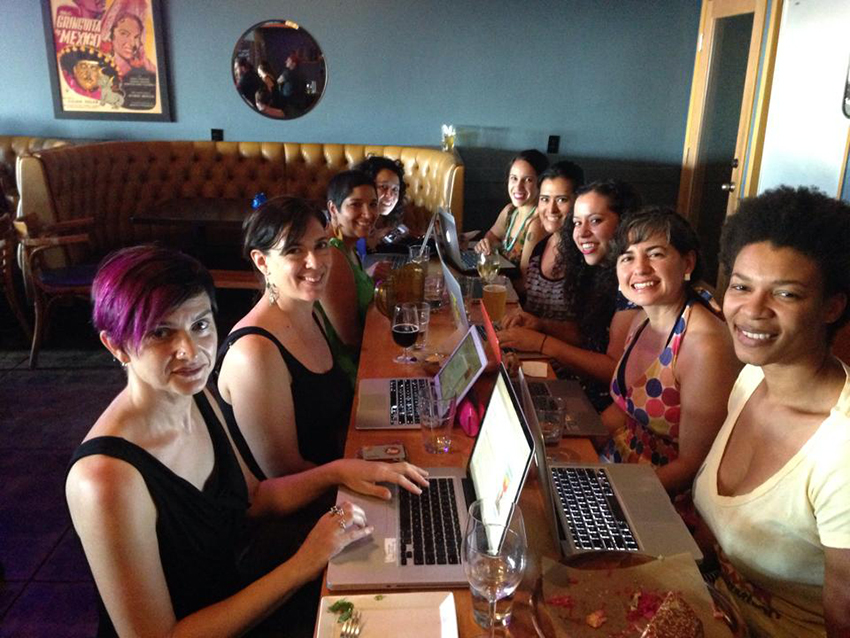
A Women Who Submit submission party

A Women Who Submit submission party

Women Who Submit was created with the idea that if we hosted submission parties—meet-ups for women writers in private homes where women could ask questions, gain support and resources, set goals, and submit work in real time—maybe more women would submit regularly, and maybe the numbers would change. Think 1950s’ Tupperware party, but instead of sharing products to improve our kitchens, we shared information to improve our chances of being published in the literary journals of our choosing.

Our first submission party was in July 2011, at my mother’s house in San Gabriel. Six women gathered around my mother’s kitchen table to create a lending library of literary journals, share food and drink, establish personal goals and submit work for publication. Every time a woman pressed “send” we cheered and clapped. And this is how the first submission party was born.

Soon after, we started to think of a name. I suggested “Ladies who Submit,” because it reminded me of “Ladies who Lunch” and thought it was a fun play on an activity seen as benign and shallow. But that got vetoed for Women Who Submit. I didn’t think much of the name at the time or the double entendre, until other women began to hear of us and make comments.

“Do you know what comes up when you Google Women Who Submit?” one woman prompted. When I tried, I found Bible versus, Christian sites, and the headline, “Submit to your Husband: Should Women be Submissive?”

Recently, our Facebook page received a message from a woman who was recommended to our site by a friend. She wrote: “I have to say, I was thrown by the name of the group. I lived through the ’50s …Cool idea…scary name.”

This statement made me realize that Women Who Submit is in fact the perfect name for our organization, because at its core it is a social action that helps women break free of societal boundaries caused by centuries of female submission.

Sometimes I think $0.77 to every dollar a man makes isn’t so bad. Sometimes I think 20% less representation in journal A isn’t so bad when journal B has equal representation. But then I think of my mother and how unbearably close it was that women couldn’t apply for credit cards, or own property, or work in an office without being harassed. The Clarence Thomas case took place in 1991, and it was only a short twenty-four years ago that the name Anita Hill and the term “sexual harassment” came into our public consciousness. And then I think of Juarez, Mexico where in the present day women are abducted and killed while on their way to work. And I think of those young women in Nigeria who were kidnapped from their beds and sold off because they wanted to go to school. And I think of women in Saudi Arabia being threatened with imprisonment and violence if they dare to drive.

Women Who Submit is a group of women who submit work for publication because they refuse to be marginalized. Through the support of community and resources we seek empowerment and equality in our chosen professions as writers, editors, and publishers. But more than that, it represents a voice for all women who refuse to be intimidated or silenced.

When I think of my mother, I think of her hard edges, her refusal to accept “no” and her ability to put her head down and do the dirty work. She’s a bulldozer, and I think maybe she got that way because no one else fought for her. No one else cheered her on. No one ever told her, “You made me so proud.”

Mom, you make me so proud!

Xochitl-Julisa BermejoXochitl-Julisa Bermejo is the 2013 poetry winner of the Poets & Writers California Writers Exchange, and her manuscript, Built with Safe Spaces, was a 2014 finalist in the Andres Montoya Poetry Prize. She has work published in American Poetry Review, CALYX, Acentos Review, Los Angeles Review, and The Nervous Breakdown. A short dramatization of her poem “Our Lady of the Water Gallons,” directed by Chicano activist and Hollywood director, Jesús Salvador Treviño can be viewed at latinopia.com. She is the creator and curator of the quarterly reading series HITCHED and a co-founding member of Women Who Submit.

https://lunchticket.org/wp-content/uploads/2021/12/lunch-ticket-logo-white-text-only.png 0 0 Christopher Pruitt https://lunchticket.org/wp-content/uploads/2021/12/lunch-ticket-logo-white-text-only.png Christopher Pruitt2015-06-03 10:21:302016-02-29 17:02:10Submission as Social Action

Issue Archive

  • Issue 29: Summer/Fall 2026
  • Issue 28: Winter/Spring 2026
  • Issue 27: Summer/Fall 2025
  • Issue 26: Winter/Spring 2025
  • Issue 25: Summer/Fall 2024
  • Issue 24: Winter/Spring 2024
  • Issue 23: Summer/Fall 2023
  • Issue 22: Winter/Spring 2023
  • Issue 21: Summer/Fall 2022
  • Issue 20: Winter/Spring 2022
  • Issue 19: Summer/Fall 2021
  • Issue 18: Winter/Spring 2021
  • Issue 17: Summer/Fall 2020
  • Issue 16: Winter/Spring 2020
  • Issue 15: Summer/Fall 2019
  • Issue 14: Winter/Spring 2019
  • Issue 13: Summer/Fall 2018
  • Issue 12: Winter/Spring 2018
  • Issue 11: Summer/Fall 2017
  • Issue 10: Winter/Spring 2017
  • Issue 9: Summer/Fall 2016
  • Issue 8: Winter/Spring 2016
  • Issue 7: Summer/Fall 2015
  • Issue 6: Winter/Spring 2015
  • Issue 5: Summer/Fall 2014
  • Issue 4: Winter/Spring 2014
  • Issue 3: Summer/Fall 2013
  • Issue 2: Winter/Spring 2013
  • Issue 1: Spring 2012

Genre Archive

  • Creative Nonfiction
  • Essays
  • Fiction
  • Flash Prose
  • Lunch Specials
  • Poetry
  • Interviews
  • Translation
  • Visual Art
  • Young Adult

Friday Lunch Blog

Friday Lunch! A serving of contemporary essays published the second Friday of every month.

Today’s course:

Being A Girl is Hard

November 28, 2025/in Blog / Shawn Elliott
Read more
https://lunchticket.org/wp-content/uploads/2025/11/Headshot_Shawn-Elliott_1500x2000.jpeg 2000 1500 Shawn Elliott https://lunchticket.org/wp-content/uploads/2021/12/lunch-ticket-logo-white-text-only.png Shawn Elliott2025-11-28 11:00:252025-12-11 17:48:50Being A Girl is Hard

Diagnosis: Persisted or Silent Inheritance

November 7, 2025/in Blog / Paula Williamson
Read more
https://lunchticket.org/wp-content/uploads/2025/12/Headshot_Paula-Williamson_1467x2000.jpg 2000 1467 Paula Williamson https://lunchticket.org/wp-content/uploads/2021/12/lunch-ticket-logo-white-text-only.png Paula Williamson2025-11-07 11:00:072025-12-11 17:48:51Diagnosis: Persisted or Silent Inheritance

The Queer Ultimatum Made Me Give My Own Ultimatum

September 26, 2025/in Blog / Lex Garcia
Read more
https://lunchticket.org/wp-content/uploads/2025/09/Garcia_Headshot.jpg 1088 960 Lex Garcia https://lunchticket.org/wp-content/uploads/2021/12/lunch-ticket-logo-white-text-only.png Lex Garcia2025-09-26 11:00:112025-09-24 11:22:02The Queer Ultimatum Made Me Give My Own Ultimatum

More Friday Lunch Blog »

Midnight Snack

Take a bite out of these late night obsessions.

Tonight’s bites:

The Lilac and The Housefly: A Tale of Tortured Romanticism

October 24, 2025/in Midnight Snack / Nikki Mae Howard
Read more
https://lunchticket.org/wp-content/uploads/2025/10/Headshot_Nikki-Howard_1770x2000.jpg 2000 1770 Nikki Mae Howard https://lunchticket.org/wp-content/uploads/2021/12/lunch-ticket-logo-white-text-only.png Nikki Mae Howard2025-10-24 23:55:032025-10-20 10:59:03The Lilac and The Housefly: A Tale of Tortured Romanticism

Dig Into Genre

May 23, 2025/in Midnight Snack / Lauren Howard
Read more
https://lunchticket.org/wp-content/uploads/2025/05/Lauren-Howard-credit-Terril-Neely-scaled-773x1030-1.jpg 1030 773 Lauren Howard https://lunchticket.org/wp-content/uploads/2021/12/lunch-ticket-logo-white-text-only.png Lauren Howard2025-05-23 23:59:492025-06-17 18:29:02Dig Into Genre

The dreams in which I’m (not) dying

April 25, 2025/in Midnight Snack / paparouna
Read more
https://lunchticket.org/wp-content/uploads/2025/04/paparouna-photo.jpeg 960 720 paparouna https://lunchticket.org/wp-content/uploads/2021/12/lunch-ticket-logo-white-text-only.png paparouna2025-04-25 23:55:312025-08-14 16:18:41The dreams in which I’m (not) dying

More Midnight Snacks »

Amuse-Bouche

Little bites every third Friday to whet your appetite!

Today’s plate:

Till Death

May 15, 2026/in Amuse-Bouche, Translation / Lorea Canales, translated by Lia Galván
Read more
https://lunchticket.org/wp-content/uploads/2026/04/galvan_headshot_translator-scaled.jpg 2560 1887 Lorea Canales, translated by Lia Galván https://lunchticket.org/wp-content/uploads/2021/12/lunch-ticket-logo-white-text-only.png Lorea Canales, translated by Lia Galván2026-05-15 12:01:552026-04-30 16:34:25Till Death

Making Friends

May 8, 2026/in Amuse-Bouche, Flash Prose / Robert L. Penick
Read more
https://lunchticket.org/wp-content/uploads/2026/04/Bob-Headshot.jpeg 1600 1065 Robert L. Penick https://lunchticket.org/wp-content/uploads/2021/12/lunch-ticket-logo-white-text-only.png Robert L. Penick2026-05-08 12:01:262026-04-30 15:56:02Making Friends

Two Poems

May 1, 2026/in Amuse-Bouche, Poetry / Jessie Raymundo
Read more
https://lunchticket.org/wp-content/uploads/2026/04/Jessie-Raymundo-Headshot.jpeg 2374 2265 Jessie Raymundo https://lunchticket.org/wp-content/uploads/2021/12/lunch-ticket-logo-white-text-only.png Jessie Raymundo2026-05-01 12:01:432026-04-30 15:36:29Two Poems

More Amuse-Bouche »

School Lunch

An occasional Wednesday series dishing up today’s best youth writers.

Today’s slice:

I’ve Stayed in the Front Yard

May 12, 2021/in School Lunch, School Lunch 2021 / Brendan Nurczyk
Read more
https://lunchticket.org/wp-content/uploads/2021/05/SL-Insta-Brendan-Nurczyk-2.png 1500 1500 Brendan Nurczyk https://lunchticket.org/wp-content/uploads/2021/12/lunch-ticket-logo-white-text-only.png Brendan Nurczyk2021-05-12 10:18:392022-02-01 13:24:05I’ve Stayed in the Front Yard

A Communal Announcement

April 28, 2021/in School Lunch, School Lunch 2021 / Isabella Dail
Read more
https://lunchticket.org/wp-content/uploads/2021/04/SL-FB-Isabella-Dail.png 788 940 Isabella Dail https://lunchticket.org/wp-content/uploads/2021/12/lunch-ticket-logo-white-text-only.png Isabella Dail2021-04-28 11:34:132021-04-28 11:34:13A Communal Announcement

Seventeen

April 14, 2021/in School Lunch, School Lunch 2021 / Abigail E. Calimaran
Read more
https://lunchticket.org/wp-content/uploads/2021/04/SL-Insta-Abigail-E.-Calimaran.png 1080 1080 Abigail E. Calimaran https://lunchticket.org/wp-content/uploads/2021/12/lunch-ticket-logo-white-text-only.png Abigail E. Calimaran2021-04-14 11:22:062021-04-14 11:22:06Seventeen

More School Lunch »

Word From the Editor

Editing issue 28, I felt something similar to the way I feel near water: I dove into my own private world. The world above the surface kept roaring, of course. The notifications, deadlines, the constant noise was always there. But inside the work, inside these poems and stories and artwork, there was a quiet that felt entirely mine. A place where I could breathe differently.

More from the current editor »
Current Issue »

Connect With Us

lunchticket on facebooklunchticket on instaX
Submit to Lunch Ticket

A literary and art journal
from the MFA community at
Antioch University Los Angeles.

Get Your Ticket

We’ll keep you fed with great new writing, insightful interviews, and thought-provoking art, and promise with all our hearts never to share your info with anyone else.

Newsletter Signup
Copyright © 2012-2025 LunchTicket.org. All Rights Reserved. Web design and development by GoodWebWorks.
Scroll to top Scroll to top Scroll to top